Demographic War: surviving conditions, demographic catastrophe and emigration of Poles from Polish lands
Current demographic demolition of the Polish nation ceases to be a debateable or contested phenomenon, it is at the mouth of everyone. There are fantastic visions of different professors. This is PLN 1000 kid support (Rybiński) and this is ... another relief for enterprises (Orłowski, “Rzeczpospolita”, 15.II.2013). There is no discussion on the main causes of the situation – the labour marketplace disaster and the housing disaster. Housing policy is essential erstwhile the wages of citizens due to unemployment, difference between the negotiating forces of the worker and the employer and the wage policy of abroad companies remains at the level of the colonial state, and housing costs have been raised upwards, beyond the scope of "median" income* Oh, yeah * employee.
The average Pole will buy 4.6 square meters of housing in Warsaw, Germany – 11 in Berlin for an yearly salary.

Source: employment data: Eurostat, costs of square metre Banker.pl
Effects? Prof. Kierzuń says: Germany has a consistent policy. In the 1970s respective 100 1000 Poles who had families in Germany emigrated. They're Germanizing. besides any of the residents of Lower Silesia already have German citizenship and practically only spends holidays in Poland and works in Germany. We will run out of skilled professionals and workers, and that will limit improvement opportunities. Only a tiny percent of them will come back. At the moment, they send money to Poland, but it will end erstwhile they bring families. And yet we are dying out as a nation, due to the fact that the statistical Pole gives birth to 1.23 children.(for: In politics.pl)
One of the mechanisms of Poland's depopulation is the mass emigration of Poles, deprived of work and prospects for uncovering it in the country. This is not something fresh in Polish history. Most Poles do not realize that specified a condition has already occurred in the past. Whenever 1 nation is forced by economical or political conditions to leave the land of fathers, and those who stay incapable to rise adequate children to sustain the population, another nation takes its place. This happened, for example, with Serbian Kosovo. The Serbs were driven out of the lands of their forefathers by a nation that defeated their demographics – partially forcing emigration through demographic and moral pressures, partially by political methods. NATO's aggression (or, in fact, the US) against Serbia has effectively finalized politically what has matured for decades demographic. Same way demographic aggressors take over the districts and full cities in Western Europe: France, Germany, Norway and Sweden. The autochthonous majority becomes a number and flees from the neighborhoods where the majority ceased to be. This escape is accompanied by the closure of business and service points, which further accelerates the process of leaving the territory by another representatives of the host nation (see video: Multiculturalisme et Islam en France study de CBN (EN subtitles)). This text can be viewed as a reminder of any facts in history, a realization of the present situation and a warning, as the future may not be optimistic.
However, let us return to the destiny of the Polish people, due to the fact that these should be the most interesting ones. Although Poles are not so far displaced from their cities, they leave them (example of the depopulation of Łódź is not unique) creating space for settlers. These will come either economically (which does not appear to be the case) or ideologically (e.g. playing diaspora – and it is not as improbable a subject as it may seem (link), especially since they are already carried out provocations to test the reactions of Polish society to akin concepts (see, for example, films by Y.Bartana and S. Sierakowski from Political Criticism, link)).
The phrase “history likes to repeat” is peculiarly valid for economical past and demography – certain laws stay unchanged. The past of the Polish nation includes both elements of Polish colonization by another nations – Germans and Jews, as well as the mass escape of Poles forced by economical conditions.
↑* ‘median’ individual – with a value of any quality at specified a level that 50% of employees have a lower strength and 50% with more, in the case of income.
Historical drawing: emigration from Polish lands 1871-1939
The genesis of the Polish emigration movement during the period of captivity is complex, due to policies conducted by 3 different invaders, for different purposes and for different reasons. The first wave of emigration occurred after the defeat November Uprising, was political due to the fact that the Kingdom of Poland was then the fastest increasing area under the Tsar scepter. The repression of the populace created the ground for the subsequent economical collapse and contributed to the backward, further established by repression after January Uprising. This created the basis for the emergence on the lands of Russian poverty. In another occupations, the causes of emigration were different. In spite of the widespread opinion that this was the “best” of the partitions, Austria had an highly exploitive and plunderive approach, resulting in a proverbial “galic poverty” and economically motivated emigration. In the comparatively well developed Prussian occupation, Poles were the mark of pauperizing, Germanizing and forcing ethnically motivated politics to emigrate. no of the invaders carried out repression against the judaic population, which willingly collaborated with the invaders and was in fact a beneficiary of the economical and demographic misery of the Polish people (cf. L. Szcześniak, “Judeopolonia: judaic State in Poland”, du. Polwen – Polish Encyclopedia Publishing House, 2001, pp. 11-19, 46-49, 67; see besides “The Golden Harvest of Isaac Luxenberg”). The backwardness and poorness resulted in besides slow growth of jobs for the increasing Polish population, insufficient growth of the housing substance – and as a consequence of emigration. Let us look at how this phenomenon developed from a statistical point of view.
...
High natural growth caused the number of non-agricultural populations – mostly casually only employed, very ill-paid(Note ed.: Today, this function is praised by various “economicists” and “free-marketers” garbage contracts), frequently fatally treated – was huge.13 Overcrowding was now a permanent part of the agrarian scenery of these lands, and this problem was not solved practically until 1945.
...
In the face of specified a situation in the villages of the Kingdom of Poland, it became increasingly popular to go to cities whose absorption was very limited at the time. In the fall of 1889, the first symptoms occurred Industrial crisis in Łódź district, which caused the vulnerability of the working environment to emigration agitation. However, it is primarily the agrarian population that will supply the basic exodus mass, which for the next decades will flow continuously to farthest corners of the world, including Latin American countries.
Source: Jerzy Mazurek, Country and emigration: folk movement towards peasant emigration to Latin American countries (until 1939), Iberian Library, 2006, p. 28
Despite the emigration of the Polish agrarian population to cities, their demographic structure began to make in a alternatively unexpected way, regardless of the economical crisis of 1889:
| 1781 | 1856 | 1897 | |
| Warsaw | 4.5% | 24.3% | 33.9% |
| Boat | – | 12.2% | 40.7% |
Source: L. Szcześniak, “Judeopolonia: a judaic State in Poland”, du. Polwen – Polish Encyclopedia Publishing House, 2001, p. 18
At the same time, the emigration of millions of Poles continued to be the best.
... From 1918 to 1938 from Poland – as determined by the subject expert, Edward Kołodziej
– for economical emigration went well over 2.2 million people, of which about 61% to European countries and about 39% to overseas countries.16
Migration in the interwar period was caused by almost the same causes as in the erstwhile period. There was inactive a large overcrowding, mostly inherited from the era before 1914. In the 1920s, it continued – despite the successively passed agricultural improvement of 1925 – at a reasonably unchangeable level, that in the next decade over 5 million.
13 J. Łukasiewicz, Agarna crisis on Polish lands in the late 19th century. Warsaw 1968, p. 198 et seq.
16 E. Kołodziej, Exit from Poland 1918-1939. Studies on the Emigration Policy of the Second Republic, Warsaw 1982, p.253.
Source: Jerzy Mazurek, Country and emigration: folk movement towards peasant emigration to Latin American countries (until 1939), Iberian Library, 2006, pp. 29, 31
As you can see, what pushed Poles out of the country was deficiency of work, deficiency of prospects and poverty. However, 1 should not underestimate the policy pursued by Prussia (‘Prussian rugs’, Colonization Commission). At the same time, however, there was a affirmative natural growth – much faster than the increase in the number of jobs in the economy, an increase in the number of housing units (overcrowding is both the number of people per occupation and the number of people per room, per square metre of surviving space). We'll be back to that in a moment.
Emigration from Polish lands after 1945
Regaining independency did not solve Polish economical problems, did not extract Polish countryside from poverty, did not lead to a dynamic improvement of industry. It was only at the end of the inter-war 20th century that the failure of the conservative economical policy led to a decision on major government expansion projects of manufacture – and COP was created. In 20 years, 2.2 million Poles left the country for economical reasons. 22 years of age III of the Polish Republic is rather akin to that of the Second Polish Republic, but the condition that the construction of something comparable to COP is not even included in the plans of the administrators. Rather, it is to sale what remains in the hands of the State Treasury.
Privatization in Polish – respective examples
Western experts shocked by Polish privatisation
In mid-May 1993, Kazimierz Skantak, a Polish economist working at the University of California, USA, received a copy of the interview he gave in the March-April issue (1993) of the diary "Journal of Business Strategy" by C. Cato Ealy, manager of the improvement of the American cellulose concern "International Paper", which in 1992 purchased 80 percent of paper shares in Kwidzyn in Poland. The dancer called the interview shocking and in an open letter protested the different practices of the said resort. According to D. P. Cato Ealy, the paper mill in Kwidzyn is 1 of the most modern in the planet and is not equal even in the United States. It was built by the world-famous Canadian company H.A. Simmons and turned it in in 1980. The cost of building this paper mill was $400 million. It was highly competitive for cellulosic companies in the West, including that American company. erstwhile his bosses learned that they could destruct a competitor and buy a paper mill in Kwidzyn on interesting conditions, they immediately reported to the Ministry of Property Transformation in Warsaw on Misia Street. The talks on the acquisition of specified a modern and crucial plant lasted highly briefly. Only 75 days have elapsed since the first conversation abroad!
The facts confirm themselves
Minister Janusz Lewandowski, belonging to Tusk's click, personally agreed to sale Kwidzyn to Americans for just $120 million, although it was worth at least $600 million! What is strange, at the beginning of the talks, the American company offered the Polish side an amount even somewhat higher, due to the fact that 150 million, which nevertheless Lewandowski graciously lowered for unknown reasons to the mentioned 120 million... After the acquisition by American companies of paper plants in Kwidzyn, the price of paper produced there increased 3 times. When, after the revelations of Mr Cato Ealy and Mr Skancelak, any Polish newspapers raised the sound around this affair, the typical of Lewandowski, Mr Garwolinska, declared to the press with a considerable, otherwise understandable confusion that the facts in question correspond to the truth, but the I.P. company promised to invest $175 million in the mill in Kwidzyn to “modernize”. The logical question is: why should he do it erstwhile the Kwidzyn paper mill is state-of-the-art?
Another “explaination” of the Ministry of Property Transformations that is reportedly a paper mill in Kwidzyn. ‘No 1 another than I.P. was interested,’ is simply a specified nonsense. Why was Kwidzyn put up for sale in the first place erstwhile it was possible to produce excellent paper needed by our country and which could be competitive in exports? And if it has already been decided for unknown and suspicious reasons to put this facility under a hammer, why was there no public global tender? After giving up for the priceless factory, the paper in Kwidzyn was inactive smoothly sold, only it cost 3 times more.
...
Podhale, which employed about 10,000 people, had to release half of its staff and thus reduce shoe production. Thanks to this drop in production, a company known for its advanced quality worldwide, a supplier to large western companies like Puma, Adidas, Royce, was redeemed for no cost.
Wedel, owned by the state, paid PLN 153 billion in taxes in 1991, or over $15 million. On the advice of the Bank of Boston, the Ministry of Property Change decided to privatize Wedel, releasing 40% of shares for Pepsico for a tiny sum of $25 million. It's hard to realize why, since Nestle was giving $40 million... In addition, Pepsico received a taxation exemption for 3 years as a bonus...
Source: Pressmix.eu, 02 Jan 2013, Donald Tusk Prime Minister or head of the power group?
What does it look like to have a terrible PRL press today? The period of the Polish People's Republic was connected with a importantly lower emigration of Poles than in another years. Within 45 years of the existence of the Polish People's Republic, 1.2 million Polish citizens emigrated. It should be stressed that a crucial part of then emigration is politically motivated emigration (it is worth noting that alongside economical emigration of Poles, the judaic population to Israel and Western European countries, frequently inspired from the outside – besides utilizing socio-technical campaigns specified as events from March 1968; this emigration besides includes the escapes of thousands of Polish-speaking Stalinists specified as Ozajasz Shechter, Helena Wolińska or Józef Light). Of course, it is hard to estimation how much emigration was reduced by administrative barriers (not issuing passports by the Polish authorities – and visas by the applicable authorities of another countries). This was described in a fresh monograph:
The number of Poles who left Poland after joining the European Union is estimated to be around two million people. Among them are young people, frequently leaving immediately after graduation, for economical reasons, without a plan to stay abroad permanently or temporarily, making a decision in this respect at a later time.
Poles can number on a good job, including in the Netherlands, Belgium and France. In fresh years the UK has been registered one million 100 1000 Polish self-employed workers. The number of people who emigrated from Poland after its accession to the European Union increased steadily, from one million 2004 to One million ninety-four thousand persons in 2011

Source: Central Statistical Office, Department of Demographic Research, Information on the sizes and directions of emigration from Poland between 2004 and 2010, Warsaw, October 2011
Source: R. Nir, M. Szczerbinski, K. Wasilewski (ed.), In constant concern
about Polish diaspora, published by the technological Association “Poland in the World”, Gorzów Wielkopolski, 2012, p. 26
What drives Poles out of Poland?
The question remains: what is happening in Poland, that young people leave and are improbable to return? Did only administrative constraints halt the departures from PRL? Are there any data to find why more Poles escape from the “free” III of Poland than from the Polish People's Republic?
We have respective series of data that let hypotheses in this area.
We wrote above that what drove out Poles in the time of partitions and from the II Polish Republic was overcrowding, manifested by the most severe deficiency of work and a large concentration of tenants in residential premises. In the 3rd Poland it happened artificial overpopulation generation. In order for the reader to realize how this happened, it is essential to look at respective graphs:
Fig. 1. Poland as a country with increasing occupation deficits: jobs, labour and occupation deficits in 1970-2010

Source: improvement of PMN based on CSO data (Statistical Yearbooks).
As you can see, from the highest point in 1980 (the highest of employment in the Polish economy peaked in 1988) in the Polish economy, 3.7 million jobs were lost. It should be added that the decrease in the number of jobs observed on the illustration between 1980 and 1990 occurred entirely from 1989 and 1990 (‘Balcerowicz Plan’). At the same time in a group of Poles aged 15-64 4 million people arrived. In 1980, the difference between the number of jobs and those considered to be a workforce was 5.5 million and increased to 13.2 million in 2010.
Figure 2. Harmonised registered unemployment and jobs created from 1993 to 2010

Source: Data OECD , series employment and Harmonized Unemployment
As you can see above, in the 3rd Republic of Poland respective million people have not been working for the last 17 years. This is the consequence of the deficiency of industrial policy, the effect of the consistent implementation of Tadeusz Syrian's thesis, that "the best economical policy is its lack". The only prescription of the government to make jobs is backing from the taxpayer's pocket of peculiar economical zones where taxation exempt companies can be installed. The managers of the III Republic, alternatively of going through a road already wiped out by Korea, Japan and China, like to beg taxation dumping for any investment in the "international capital" so that they do not gotta invest in the production assets themselves, so as not to plan the economical improvement of the state.
But Poles are not only driven out of the country by the deficiency of work – and as a consequence by the deficiency of the anticipation of maintaining a family. The situation on the housing marketplace is an crucial component of the Polish problem. Polish housing substance was destroyed by war. In the post-war period, due to the strong industrialisation and migration of the population from the village to the cities, despite the efforts of the authorities, the housing needs were not satisfactorily met. However, governments had a very active housing policy, given the limited resources they had at their disposal. Housing policy has translated powerfully into the number of children born:
Figure 3. Numbers of built apartments and born children in the last 40 years. Statistical analysis of the above data shows a very strong relation between them. After taking into account the shift over time, the correlation coefficient (Pearson) is 94.1%.
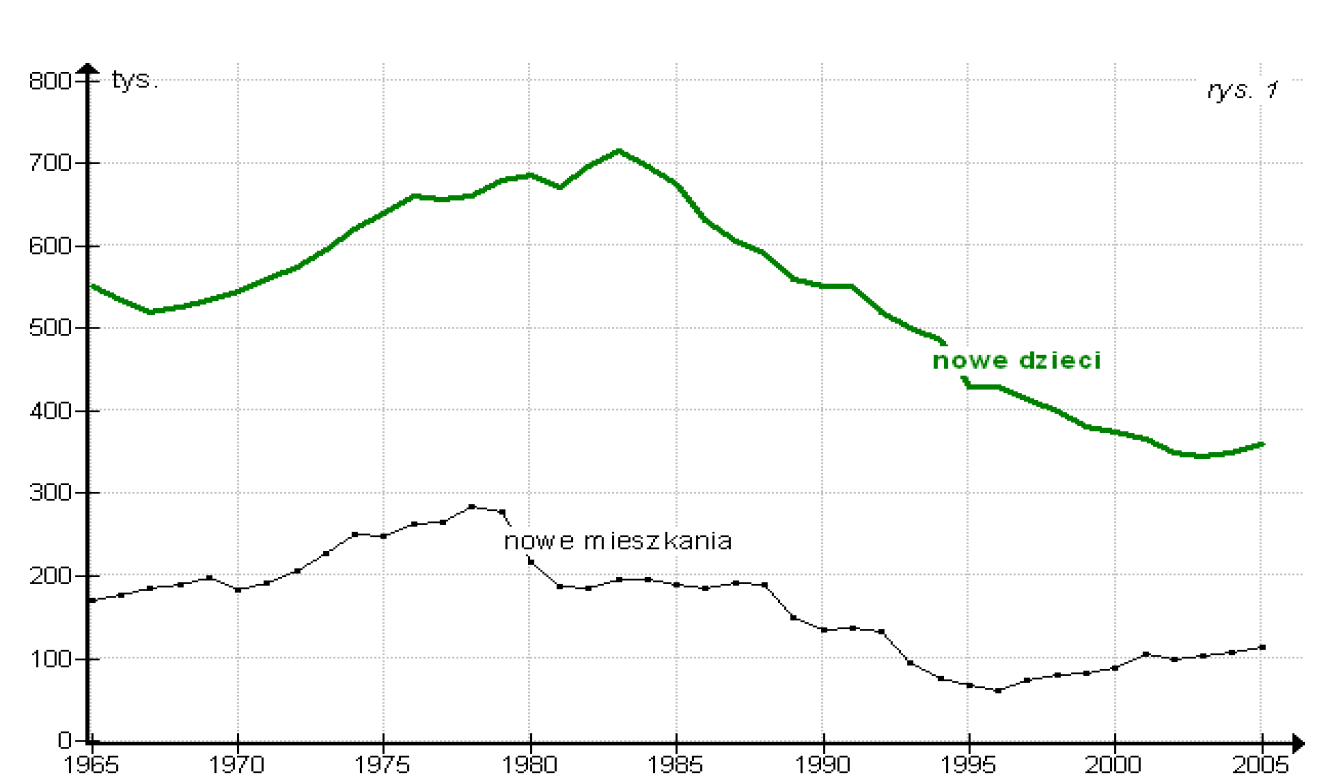
Source: Piotr Witakowski (ed.), “Report 2006. On the repair of the housing situation” , Warsaw, January 2007, p. 82
For more information on this statistical relationship, along with the econometric model, see the text Demographic Disaster III of Poland. any researchers argue with the observed regularity, saying that dependency is apparent due to the fact that in the PRL the number of dwellings was planned to take into account the needs of the demographic structure, and as a consequence the number of children born is determined solely by the demographic factor, as is the number of dwellings. The mistake of this reasoning is rather apparent and easy to demonstrate. The statistical dependency was calculated taking into account the disaster in housing construction, which occurred in the 3rd Poland. If the number of children born were related solely to the number of working-age populations, there would not be a sharp decrease in birth rates in the 3rd Poland, recorded for the early 1980s demographic boom. As a result, the observed correlation value of Pearson (and the econometric model determination factor) of the number of dwellings with the number of born children would be lower. In another words, the impact of the number of housing units placed for usage on the number of births is demonstrated by 2 experiments. Between 1975 and 1985, the demographic surplus hit a advanced supply of housing, we got a advanced number of births. In 2000-2010 children born then should have their own families and their own children. If nothing had changed, we should have a second wave of the same tallness as between 1975 and 1985 (see Figure: Demographic losses due to systemic transformation.). That's not what happened. In 1 generation, the fertility fell from more than 2.1 (a minimum essential to keep the population) to about 1.23. How changed surviving conditions at this time? There was a collapse in housing, the liquidation of the manufacture built in PRL caused multimillion permanent Unemployment, Poles with no prospects for work or housing (pay not allowing to buy an flat is besides an effective method of depopulation) in their home country began to emigrate massively.
Fig. 4. Apartments put into service in individual years and distribution of surviving births.

Source: Piotr Witakowski (ed.), “Report 2006. On the repair of housing situation” , Warsaw, January 2007, p. 6
Figure 4 shows not only the relation between the number of dwellings built and the number of children born, but besides the fact that the area of dwellings donated (the ratio of the full area to the number of dwellings) grew during the PRL period. erstwhile compiling these data with the table in Figure 5, it was not only possible to improve the level of gathering household needs for housing, but besides to improve the comfort of hybrids (larger conversion area per person). This situation began to deteriorate after 1989, i.e. despite further improving the comfort of those who had housing, the housing deficit increased. While the deficit increased from 1970 to 1978 due to the entry into production age of the demographic boom despite The increasing number of housing units, but in the 3rd Poland the demographic surplus in the production age did not come into contact with any initiatives ahead of the country in the area of housing policy. Inactivity of the state led to a situation where the housing deficit reached unprecedented values in the PRL (see first row of the table in Figure 5).
Figure 5. improvement of the housing situation in Poland

Source: Piotr Witakowski (ed.), “Report 2006. On the repair of housing situation” , Warsaw, January 2007, p. 10
In the study there are any crucial wordings that we will quote here in full: The analysis of the data contained in Table 2 (above) and Table 3 shows 2 seemingly contradictory trends in housing developments after 1988. On the 1 hand, the construction of fresh housing continuously increases the average standard of existing resources, while the availability of housing continues to deteriorate and their deficit is aggravated. If this deficit was 1253 000 housing units in 1988, it had already reached more than 1767,000 housing units in 2004 and is steadily increasing. The fact that the state has left the housing strategy to a marketplace mechanics means that those who can afford the flat are becoming more and more large, while they are a percent smaller group. The decrease in the number of dwellings built after 1988 was so extremist that even the trend towards “rejuvenation” of housing resources has been reversed and they are now systematically ageing – the average age of housing in 1978 was 33 years, while in 2002 it was 41 years. (op. cit., p. 11).
1 W. Korecki, W. Rydzik, L. Kałkowski "Consolidation of housing with the national economy". IGM, Warsaw 1994.
Source: Piotr Witakowski (ed.), “Report 2006. On the repair of housing situation” , Warsaw, January 2007, p. 6
As we can see, the 3rd Polish nation is simply a defeat of the Polish nation – a disaster of unprecedented proportions in Polish history, due to the fact that the Polish nation, after destroying the material foundations of its existence, depriving it of its influence on economical policy, after economically undercutting its ability to regenerate demographic defects (demographic robbery economy) is driven across various countries of the European Union, which only accelerates the demographic demolition of the population in Poland. Never before in the past of the Polish nation of mass economical emigration has it been accompanied by negative demographic growth in the country. Since emigration involves either putting the kid distant for the future, or deciding to have children outside Poland – many children will not be born at all, or they will join permanent emigration, not returning to Poland. The graphs showing the demographic situation, the labour marketplace disaster and the collapse on the housing marketplace presented above do not encourage to return to Poland. All these factors have a strong impact on how Poles feel in their own country. A certain different measurement of changes introduced in the quality of life of Polish society in the III Polish Republic can be very sad statistics:
Figure 6 Change in suicide rates, percentages, 1990-2010

Source: oecd-ilibrary.org
Bankruptcy of the 3rd Republic of Poland is inevitable. Can we avoid the demographic demolition of the Polish people? Can we save Polish statehood and regain lost economical and political sovereignty? The chances of that go down all year.