It was a mistake that the Polish People's Republic did not carry out technological investigation on the Ukrainian nationalist movement of the fascist type. The problem was thought to have been solved and it was another illusion. During this time, Hitler's Ukrainian collaborators played an crucial function in the American propaganda machine, developing their own version of the communicative adopted as actual by J. Giedroycia. A full squad of myths about “herohood” of the alleged UPA of its expected fights with Germany and the Soviets was transferred to Poland in the breakthrough year of 1989.
The main effort of the CNS-UPA after the war focused on countering resettlement action, Ukrainians were terrorized, who expressed their desire to go to the USRR. Bands destroyed railway tracks, carriages, bridges, 2 railway stations, burned over 25,000 Polish and Ukrainian homesteads after displaced Ukrainians, thus preventing Poles arriving from the east Borders from settling in.
In the post-war borders of Poland, OUN-UPA murdered about 15 1000 Poles, about 1,500 WP soldiers, over 500 militias and Armenians were killed in the fighting with the gangs. About 5,000 Ukrainians were killed during the fighting, any of them at the hands of UPA for helping Poles or for refusing to cooperate (On line No. 88/2006). The resettlement of the Ukrainian population should so be clearly demarcated from the fighting against UPA troops during which the civilian population was killed.
The military aimed at the area of Rzeszowski state and Lublin region suffered dense losses, trained for front tasks, was not prepared to fight bands, quartering in Ukrainian villages and bunkers. The main task of the army was to organize and defend displaced Ukrainians for the USRR, as well as to defend the Polish population. They continued to fight armed bands of flagmen who attacked recently formed guards and checkpoints.
MASAKRA IN JASIEL
In Jasiel, Sanok was killed or murdered as a consequence of the UPA attack after the surrender of 89 WOP soldiers and 5 militias from Komańcza During the evacuation of the threatened WOP facility in Jasiel, there was a sotnia attack: “Chrina”, “Didika” and “Myrona” (according to G. Motyki), others besides service the sotnia “Bira”. According to the WOP archive in Jasiel, 108 WO soldiers and 5 militias from Komancza defended themselves, the flags were over 500. 104 WOP soldiers (including 11 wounded) and 5 militias were captured. On March 21st, the commander of the defender was murdered. “The Ukrainians chained 1 leg to the fir branch and the another to the horse harness. The body was torn up in the air" (Jan Rajchel: “The hard days of Jasiel”); in: Gazeta Bieszczadzka, No. 25 of 10.12.2015). His wife unsuccessfully tried to learn from the military authorities about her husband's fate, but only in 1975 did she learn the fact from the book publication Teofil Bielecki and Jan Ławski "When the last shots were silenced", published in 1969. It is not known why the military hid this information, which had been in the military archive since 1946. Only after more than 30 years did the wife find and visit her husband's grave for the first time (Siekierka..., pp. 982 – 983).
In the village of Komańcza, the Sanok overtook the WOP defender and killed 6 Poles in the village. On the destructions made by UPA at night from 21 to 22 March 1946 by UPA, “Sanock Yearbook” Volume IV states: “In the space from Komańcza to Skull the full railway line demolished. All bridges burned, telegraph poles cut and burned at the stake. In places full sections of the railway track along with the backings thrown into the river. Between the m. Wet and m. Skulls were pulled from the embankment of the railway tanker with oil and armored wagon and locomotive, which was subsequently burned. Road bridges, from Komancza to Tarnawa, all burned. The attack on the Komańcz cluster from March 21 on March 22 besides had tragic consequences. Banders dressed in part in Polish uniforms burned down the railway sanatorium building (in Summersk), the erstwhile politician Klimov building, the Border defender Station, the Drozdowa teacher building, which housed a private Polish school and a dairy house. In addition, a railway defender was burned down, the Hirsch militia building, the Kasiewicz mayor building, the Dr. Heller building, which housed the MO station, and 2 railway warehouses. The Drozdov teacher was burned with the school building, and her sister, Kułak, was killed. The upswings besides kidnapped and shot Milicits Błaszczak and Latuska, Lieutenant Gerasik and Railwayr Gońca. UPA besides intended to burn the Nazaretanek monastery – at the insistent request of the superior of the monastery, the uppers managed to dissuade from this intention." In fact, the monastery was not burned due to the fact that it was frequently hidden by injured uppers. In the fire of the house, the school manager Louis Drozd and her sister teacher Maria Kułak died. Part VII’; in ‘Bieszczad’ No 212/2016).
EXPECTION
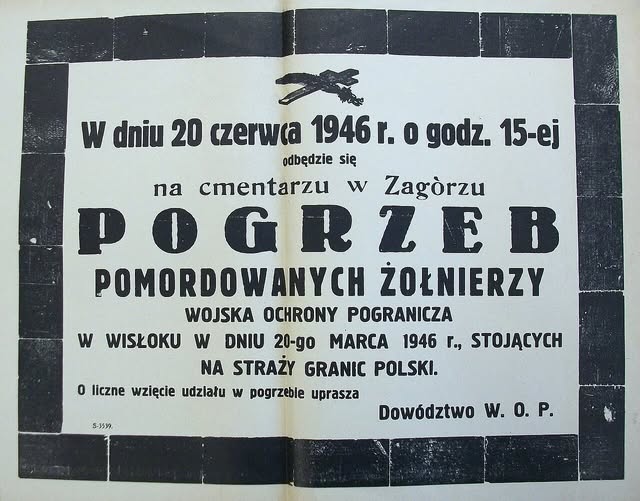
The facility in Jasiel, as well as another surrounding areas, ceased to exist. The survivors of the massacre and the soldiers released to freedom continued to return to theirs for respective days. The exhumation of the dead took place until June 1946. There's been a evidence of excavating the body and re-burialing:
"On Saturday 15.VI.1946, a commission consisting of 5 officers and 28 soldiers headed by a leading soldier who knew the place, due to the fact that he fled the scene of the murder, decided to find whether or not there were actually murdered. At 12.15 p.m., we arrived at a place which was located in a tiny mountain forest, 1 km from the last home of the village of Wisłok1 by the Ukrainian population. After walking 500 m with a cane, we found ourselves in a tiny boiler, which was divided from the road by immense steams, and here the lead soldier indicated where the bodies of the murdered were to be found. We dug up a gap about 75 cm in diameter with our scapulas and found 1 of the murdered. These hands were bound by cords, and the body was already covered with white scraping epidermis. We took a image of this place, then covered and masked as before, i.e. moss and fallen leaves? We're gone. [...] During 3 days we prepared crates, wagons, cars and set off on Wednesday at 7am for the corpse. We insured the place with 100 soldiers, then began to mine the corpse. 30 cm from the surface was the first layer of corpse. Half of the second layer had tied hands and legs, any even with wire, while the another half had restrained hands only, from where we came to the conclusion that at the time of the weapon escape. The bander suds began to restrain their legs to prevent escape. In the 3rd layer there were 3 bodies that had stripes on their necks, but the doctor stated that they were not hanged, but were impossible to massacre. any bodies had no eyes or noses. After loading the body 3 to 1 crate, we transported it with carts, then with cars to fresh Zagórze, where we moved the body into coffins. [...] Military, civil, various organizations, schools and local population arrived at the cemetery on 20.VI.1946 at 15 p.m. The priest there performed a ceremony ceremony. At the end of the orchestra played the national anthem, the honorary composer gave a three-time salute in honor of the fallen, while at the same time bubbling all the sirens located in Nowy Zagórz. Of the 36 excavated corpses, 2 were recognized by the household and taken away. They were militias from Komańcza.”
Paweł Sudnik“ They all had to lie face down to the snow. A fewer of the flagmen have begun to rip off our uniforms. The first soldier was thrown into the pit and 1 of them shot him in the back of the head and killed him. Then they pushed me to the edge of the excavation.” The restrained private unexpectedly jumped into the ravine himself. In spite of the fire, moving zigzag, he escaped the chase. A wounded man in the thigh and ear managed to hide under a snow-covered young spruce, where he waited out the passage of the manhunt. The injured man managed to distance himself from the execution site for 12 kilometres. As it turned out, he reached Jaworowa Wola, here he stumbled upon children cutting off twigs. He was saved by local peasant Wojciech Szwab, who brought his shoes and clothes, took him to Bukowska the next day, where he was transported to Sanoka by Szczawne, then to the infirmary in Sanoku.
The Provincial Office in Rzeszów alerted the authorities to inform them that there was no state or local administration in the field, the broken telephone communications made communication difficult. UPA is provided with logistical assistance and an effective intelligence network.
In a desperate situation, the State authorities decided to carry out operations under the code name “Wisła”.
Danuta Wojciechowska

-626696fc-1200x675-a287546f.jpg)