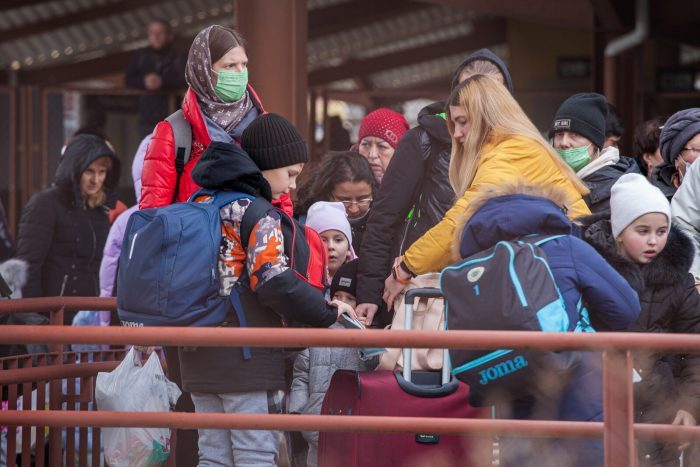
 Migrants from Ukraine arriving in Poland / Source: author: Mirek Pruchnicki flickr.com
The words "immigrant" or "immigration" rise quite a few concerns, and the continued discussion of immigration by politicians only intensifys these feelings. We are frightened that dangerous immigrants are "dragging" us. At the same time, we hear that we request foreigners and should receive them. We are constantly warned that immigration is the biggest threat to Poland. But are you sure? Putting aside prejudice, let us focus on how the situation concerning immigrants in Poland truly looks.
Many myths have grown around immigration, which now frequently become a tool in the hands of politicians who argue the process. A large part of Polish society besides opposes immigration. Many see many threats, specified as labour marketplace difficulties. The results of the survey “Collection of Poles with the Word” are a crucial confirmation of this immigrant” conducted in 2025 by CBOS. It is clear from them that Poles and Poles are little favoured by foreigners, if in the asked question they are referred to as “immigrants” alternatively than “foreign”. The percent of affirmative "foreign" attitude is 70%, but in the case of "immigrant" it is only 58%. CBOS itself points out that specified a survey was prompted by the reflection of media disputes on immigration issues. Researchers, on the basis of the situation observed, have come to the conclusion that a sharp political dispute over immigrants has contributed to expanding public reluctance towards this group. In order to prove the thesis, people active in the survey were asked about their attitude towards immigrants and their attitude towards foreigners who settle in Poland. The results clearly indicate that Poles and Poles have a better feeling about foreigners than immigrants, even though both groups are actually the same foreigners. The results of the investigation show that the disputes of politicians and the “terror” of Poles with immigrants left their mark on the perception of foreigners and led to increased concerns about immigration.
Immigrants in the labour market
The exact number of immigrants in Poland is hard to determine. Government estimates indicate about 2.5 million immigrants, a akin number is besides reported by the Warsaw Enterprise Institute. Of all immigrants, the number of active and insured persons in ZUS is around 1.2 million. Regarding the origin of foreigners residing in Poland, the vast majority of immigrants (about 70%) are Ukrainians. The Deloitte survey for UNHCR of June 2025 shows that last year Ukrainian refugees made a crucial contribution to generating 2.7% of Polish GDP. Moreover, the increase in the number of Ukrainians in the labour marketplace did not lead to unemployment among Poles or a decrease in real wages. We are dealing with the other phenomenon due to the fact that in 2024 the percent of Polish citizens working increased. The study besides shows that refugees from Ukraine are primarily engaged in the simplest work. Only 12% of them work in managerial or specialist positions compared to 37% Poles, although for both groups the percent of people with higher education is similar. This fact makes it possible to conclude that even educated immigrants, to a very tiny extent, are becoming competitive in the labour marketplace of skilled workers. A large part of this group takes up professions that do not require expertise or higher education. usually these are jobs which Poles are reluctant to undertake, for example due to lower wages. However, this situation is not clearly positive. CSO data for 2024 indicate that there are many municipalities in Poland where the median earnings were small higher or even little than the minimum wage. Migrants are much more desirable for jobs offering minimum wage. This is due to the fact that in the vast majority of cases, abroad employment is cheaper and foreigners themselves are more susceptible to exploitation at work. At the same time, 1 of the main reasons for employing foreigners is the gap in the labour marketplace – PwC estimated the shortage of workers in Poland in 2025 for about 1.5 million people. The number of vacancies is so uneven across the country. This leads to different phenomena in different places in Poland. In 1 option, immigrants are a preferred group of staff occupying most vacant posts, and in the another they fill the gap resulting from a shortage of workers.
Benefits recipients?
One of the main arguments raised against immigration is the excessive usage of social benefits by immigrants. The expanding number of foreigners in the country raises concerns about the dense burden on the strategy of benefits and, consequently, the increased burden on Polish taxpayers. peculiarly controversial is the issue of the 800+ benefit, which was paid to foreigners (now only working foreigners are entitled to this benefit). The aforementioned Deloitte study shows that despite the payment of social benefits to this group (including 800+) amounting to approx. PLN 2.8 billion in 2024, the working citizens of Ukraine have paid more in taxes and contributions to the state budget – approx. PLN 15.21 billion. However, the wellness benefits paid to immigrants from 2023 amounted to about PLN 800 million. By deducting the amount of benefits paid to immigrants from the sum that foreigners supply to the state budget, we receive over PLN 11 billion inactive remaining in the budget. On the another hand, the frequently raised issue is that foreigners receive unpaid benefits. We are talking about collecting 800+ benefits for children who do not live in the Polish country at all. Since September last year, however, the rule has been introduced that benefits are paid only to children in the Polish education system. According to Minister Barbara Nowack, about 39 1000 children arrived in the Polish education strategy erstwhile this rule was introduced. This phenomenon would propose that these children were previously not within Poland or remained online in the abroad education system. By treating this as an abuse of the benefits available, we would receive a maximum amount of abuse of around PLN 400 million. This so excludes the thesis with excessive strategy load. In turn, there is small in Poland for people who do not work among citizens of another countries — possible beneficiaries of benefits. According to the Warsaw Enterprise Institute in the September 2025 study "Avoid Western mistakes", the employment rate among foreigners in Poland in 2024 was 84.8% and is 1 of the highest in Europe. Interestingly, experts as a reason for specified advanced professional activity of immigrants in Poland have given a little developed social welfare system. This origin is intended to motivate foreigners to take up employment.
Immigrants and Crime
The fear of expanding crime as a consequence of immigration is present in Poland on a large scale. Politicians outrun the daredevils, too, that a large proportion of immigrants arriving in Poland are entering into conflict with the law, thereby affecting the safety of Poles and Poles. In their narration, politicians seldom follow proven data, which only leads to an exacerbated conflict between different policy options and increased public concerns and prejudice. 1 reason is, for example, the fact that in 2024, according to the IMF, there were 339% more attempts to illegally cross the Polish-Belarusian border than in the erstwhile year. State action, specified as sealing the east border, as well as the intensive work of the services, helps prevent illegal immigration and helps reduce crime among foreigners. According to the data of the Police office in 2024 foreigners accounted for about 6% of the Polish population. However, they were only liable for about 5% of crimes and accounted for 4.2% of the prison population, i.e. they broke the law little frequently than Polish citizens. It is worth noting that the general crime in our country is taking a downward trend over the years. Thus, the increase in the number of immigrants in the country does not increase the overall level of crime in Poland. Moreover, the decline in the number of crimes committed has besides been observed among immigrants in the country. In 2024, there was a decline in crime in this group by about 6%. The most common incidents involving foreigners are: theft, possession of illegal substances, driving under the influence of alcohol. The decline trend among immigrants is argued by increased service work. More and more cases of deportation after serving a punishment combined with a ban on entry into the Schengen area are an effective incentive to comply with the law in force in Poland.
We are constantly flooded with information about immigrants utilizing social benefits, conflicting with the law and taking jobs from Poles. However, most of these statements are exaggerated and cannot be confirmed in the data. Immigration is an inevitable phenomenon that we are experiencing present and we will be experiencing in the future. It is besides a substance of large emotion, most frequently the negative ones. Poles fear for their own safety, the situation on the labour market, and the distribution of social benefits. This fear, driven long enough, can lead to panic and irrationality. It is so crucial to follow facts. Both national decision-makers and average citizens should effort to put their emotions aside and look at immigration in the most nonsubjective way possible — considering losses and benefits.
Roksana Świętochowska







![Wzmożone działania prewencyjne policji w rejonie szkół powiatu kłodzkiego [zdjęcie]](https://storage.googleapis.com/intergol-pbem/nowaruda24/articles/image/7f67d8b3-60c3-4b0d-a6d2-3c485675a2cd)

![Rażące błędy śledczego. Prokurator nie chce ścigać Tołwińskiego za wspieranie Rosji [TYLKO U NAS]](https://cdn.oko.press/cdn-cgi/image/trim=78;0;83;0,width=1200,quality=75/https://cdn.oko.press/2026/10/tolwinski7.jpg)