President Nawrocki interrupts his journey to Senegal, the national media study a coup, and Prime Minister Tusk states: “It is our work to reconstruct the regulation of law. After years of writing lawlessness is simply a difficult, sometimes painful process and requires decisive action. There is no another way." That's what the last hours are about. Constitutional Court.
Most Poles, proceeding about another conflict around the Court, are most likely asking themselves: what precisely is the matter? Why has political confrontation been taking place around an institution whose task is to guarantee compliance with the Constitution for eleven years? And why didn't the change of government solve the problem?
To realize current events, you gotta go back to 2015. Then the crisis began, the effects of which the Polish state inactive feels.
Court, i.e. the court of law
The Constitutional Tribunal is no average court. He does not settle disputes between citizens, does not convict criminals and does not deal with typical civilian matters. Its primary task is to check whether the laws and another acts referred to in the Constitution comply with the essential law.
In Poland, the Court creates 15 judges elected by the Sejm for nine-year terms. This is important: judges are not elected by the president or by the government. The president takes a vow from them, but the constitutional competence of choice belongs to the Sejm.
It was around the cast that the conflict began.
Year 2015. First PiS mistake and Response
In June 2015, erstwhile the parliamentary majority inactive had the PO-PSL coalition, a fresh Constitutional Court Act was passed. Its rules supply for the anticipation of electing 5 judges until the end of the word of office of the Sejm.
Meanwhile, the word of office of the 3 judges ended in November, and 2 more were not until December 2015, which is after the fresh Sejm began.
October 8, 2015 The Sejm chose all five. It was besides a decision that included 2 seats, which should already belong to the next parliament.
After the parliamentary elections, power took over the Law and Justice. The fresh majority contested the choice of predecessors, and on 2 December 2015 elected another 5 judges.
This led to a double choice of 3 positions.
December 3, 2015 The Constitutional Court, in its judgement of signature K 34/15, decided that the election of 3 judges by the erstwhile Sejm was in accordance with the Constitution, while the election of the another 2 was premature.
Despite this decision, the president Andrzej Duda did not take a vow from 3 decently elected judges. Instead, he took a vow from the people chosen by the fresh majority for the same positions.
This is how the word "doublers judges" appeared.
It was the actions taken by the Law and Justice Service that led to a situation in which people elected in the Court had already been legally appointed.
Another year. Court under the control of the fresh majority
In the following years, the Law and Justice have rebuilt the functioning of the Court and filled further vacant positions. She led him. Julia Przyłębska.
The issue was no longer limited to 3 people called doubles. There were besides doubts about the Court's independence, the way in which the rulings were appointed and its relation with the executive authority.
In 2021, the European Court of Human Rights in the Xero Flor case against Poland challenged the position of the Polish Court of Justice, in which the individual elected was involved.
This was not just a national political brawl. global institutions have besides seen the problem.
For 8 years, the Law and Justice have become an institution whose rulings and way of functioning have been subject to increasing controversy.
Year 2023. Government change didn't solve the problem
Following the 2023 parliamentary elections, the coalition with the participation of the civilian Coalition, the 3rd Way and the Left took power.
The fresh majority announced the restoration of the regulation of law and the repair of state institutions, including the Constitutional Court.
In March 2024, the Sejm adopted a resolution to remove the effects of the 2015–2023 constitutional crisis.
The government ceased to print part of the Court's rulings, questioning the correctness of its compositions. This besides caused legal disputes. The Constitution provides for the work to print decisions of the Court.
New legislative solutions concerning the functioning of the TK were besides prepared. However, the process of change encountered obstacles related, among others, to the position of president Andrzej Duda.
In practice, it turned out that the fresh coalition itself was not adequate to order the situation.
Moreover, any of the actions taken by the fresh majority were criticised by lawyers as legally questionable.
In this way, the conflict that was to be concluded entered another phase.
Year 2026. fresh judges and another crisis
On March 13, 2026, the Sejm elected six fresh judges of the Constitutional Court to hold vacant posts.
President Karol Nawrocki He took a vow from only 2 of them. The others vowed during the ceremony in the Sejm, not considering that the President's absence should prevent them from taking office.
The Sejm considers that the choice of all six persons was effective and consistent with the Constitution. The president questions the correctness of this procedure.
As a result, the dispute over who is the justice of the Court remains unresolved.
October 30th. The conflict is transferred to the Court’s seat
Another escalation took place on Friday 30 October.
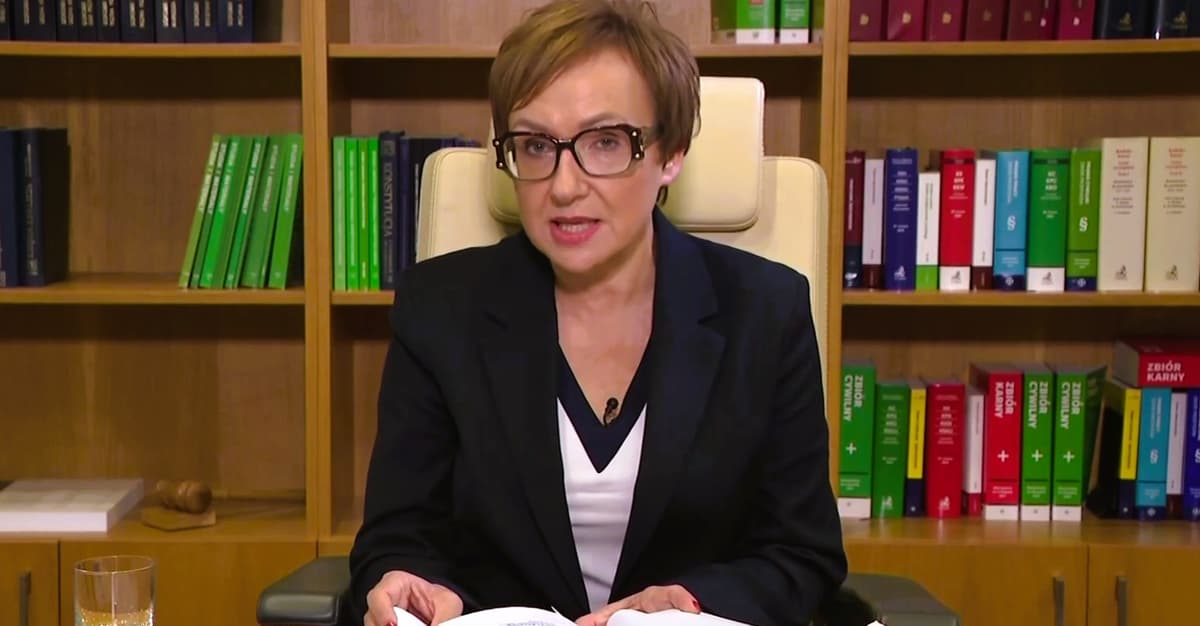
Referee Anna Korwin-Piotrowska, who had the longest stint in the Court, ordered a monthly break in the work of the president of the Constitutional Tribunal Bogdan Święczkowski and vice-president Bartholomew Sochanski.
The basis for the provisions on immediate interruption in the service of the judge, in peculiar Article 130 of the Law on the General Courts, applicable in connection with the provisions on the Court.
Korwin-Piotrowska justified, inter alia, the blocking of the participation of all decently elected judges in the General Assembly and the way in which the rulings were appointed.
Święczkowski did not consider this decision legal.
Around the office of the TK, police appeared, protesters gathered outside the building, and president Karol Nawrocki interrupted a abroad journey and came to Warsaw. On the night of 30 to 31 October, he personally appeared at the Court's headquarters.
These events led to another sharp conflict between the representatives of the current ruling majority and the president and the environment associated with the current leadership of the Constitutional Tribunal.
Who's right?
The most honest historically conclusion: the crisis began the PO-PSL coalition, attempting to prematurely fill 2 judges' posts. The PiS, alternatively of limiting itself to questioning that part of the selection, besides challenged the correct selection of the 3 remaining judges and placed their seats in their own candidates. Thus, he made the mistake of his predecessors a tool for taking control of the Court.
The current conflict shows that politicians (and personally Tusk I Kaczyński) could not come up with a solution that would reconstruct the Court's widely recognised position and end the dispute over its composition.
The biggest loser of this long-standing conflict is simply a citizen
The Constitutional Tribunal should be an institution to which a citizen can have assurance regardless of who presently holds power. He should control the laws passed by both the right and the left, by the government of Donald Tusk and his political opponents.
Meanwhile, for eleven years alternatively of settling constitutional disputes, he himself is their main hero.
And as long as the most crucial decisions concerning the Court are made primarily in the logic of political confrontation, it is hard to anticipate that the situation will change quickly.
Is the Constitutional Court even needed?
The multi-annual crisis around the Court besides raises a much more fundamental question: does Poland request a separate Constitutional Court at all? After all, 1 could consider a solution consisting in its liquidation and transfer of powers of constitutional control to the ultimate Court. In specified a model, judges of the ultimate Court, alternatively than a separate body whose composition is straight shaped by decisions of the parliamentary majority, would be liable for examining the conformity of laws with the Constitution.
Such a solution would, however, require a revision of the Constitution of the Republic of Poland, as Articles 188 to 199 establish the Constitutional Court as a separate body of judicial authority and specify its competence. A simple bill would so not suffice. In order to amend the Constitution, the procedure referred to in Article 235 thereof, including a majority of 2 thirds of the votes in the Sejm with at least half of the statutory number of Members and an absolute majority in the Senate, is needed. It is worth taking up this debate due to the fact that the institution set up to defend the primacy of the Constitution should not itself become a tool of political force and the object of the fight for influence.
→ Peter Tip
31.10.2026
• illustration: TK / barma Tribunal newspaper
• more texts and statements by the author: > Here.
adw. Peter Advice (born 1987) is simply a pseudonym utilized in analytical texts. The author is simply a postgraduate of the Faculty of Law and Administration of Adam Mickiewicz University in Poznań, a partner in the Warsaw law firm. Since 2025, he has been working with the “Gazeta Trybunalska” in a non-profit formula, publishing accessible legal comments and analysis of judgments.