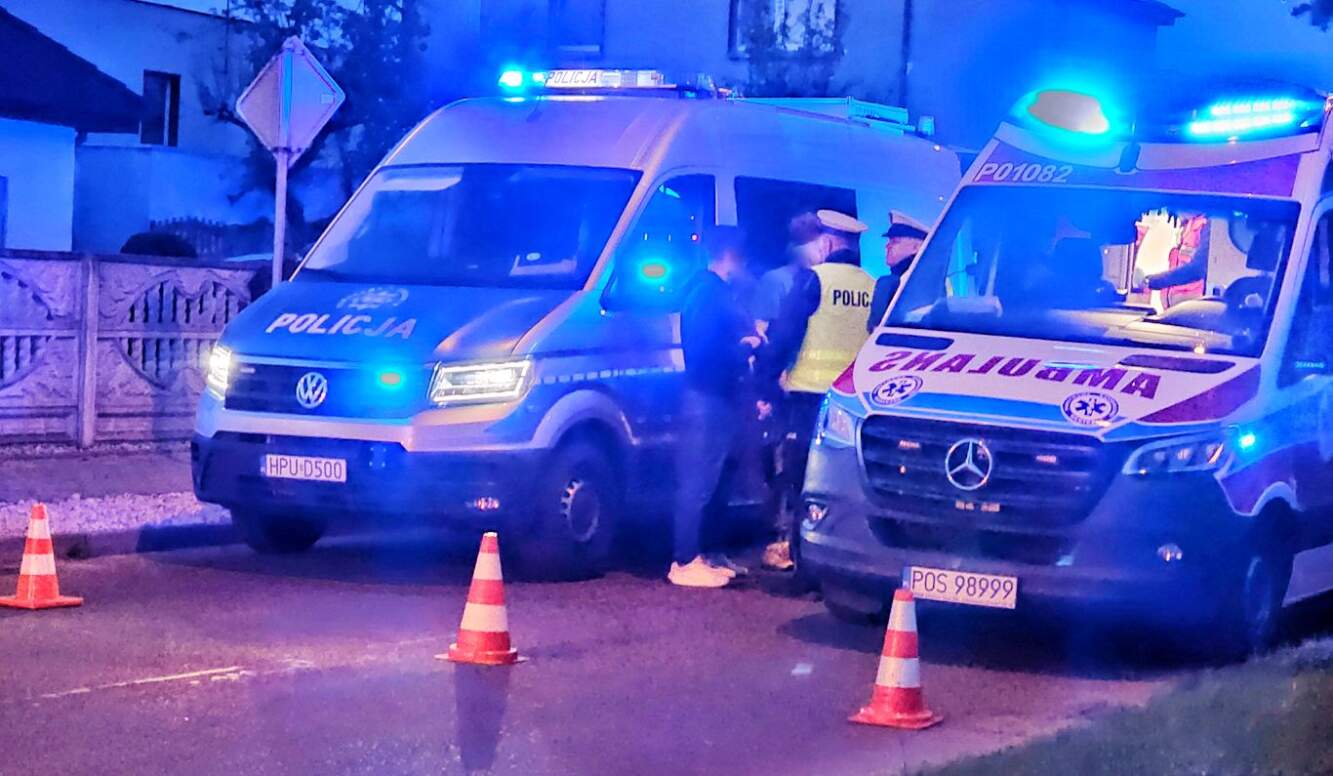
Friday morning. They come from various, frequently distant from the regional capital. There might even be a 100 tractors. They have Polish flags and banners with slogans: "It's not a strike, it's a fight for survival", "Polish farmer, Polish grain, Polish bread on the Polish table", "Government eats and dances and the farmer goes bankrupt", "Stop Mercosour", "The Union will not spit in our face"
In the capital, even about 1,000 tractors took to the streets. Farmers, producers, farmers, not terrible colds and hundreds of miles to go.
Behind the protest is the Lower National Farmers' Protest.
Some of them powerfully support: "The wall on the Polish farmer", "Don't Give Up!", "Fight For Yourself!", others reprove EU grants and passivity for the governments of the PIS.
"If we do not show solidarity today, next day the next farms will vanish from the map of Poland. If we are together – we have strength. We will not quit the Polish village. We will not let individual farmers to be destroyed" – the representatives of NSZZ Individual Farmers "Solidarity" warm up to fight in social media.
STOP Mercosour
What's all this about? What are Polish farmers afraid of? Why are they storming the capital? And why don't they want Mercosour?
Mercosur is simply a trading block focusing Argentina, Brazil, Paraguay and Uruguay. The agreement with the EU is to abolish duties and open markets on both sides of the Atlantic. For European farmers, this means the hazard of flooding the marketplace with inexpensive meat, soya or sugar.
And there is simply a immense opposition. They fear tremendous competition and loss. The agreement is not only opposed by Poland, but besides by France, Ireland and Hungary.
Farmers have identified respective major risks:
Inflow of cheaper food from South America, whose production takes place at lower costs and milder environmental and sanitary standards.
Inequal competition, due to the fact that European farms must respect strict regulations and Mercosur products must not.
The fall in prices and cost-effectiveness of production, which peculiarly affects tiny and medium-sized household farms, which may not last the force to import inexpensive meat, soy or sugar.
Simply put, they fear that the agreement will negatively affect Polish agriculture, hit farms, lead to bankruptcy. The costs will be borne by the village. On the another hand, the benefits of the agreement can mainly scope another sectors of the economy, while the costs will be borne by the village.
The European Commission is recovering emotions and offering farmers additional financial support of €45 billion from 2028 and temporary abolition of fertilizer duties. That's how he wants their support.
But Polish farmers are not bribed. They're determined. First, they storm the Internet, print the road report, then the capital. Ready to fight for their future, they met at 11 in Defilad Square (under the Palace of Culture and Science) and march under the Seym at Wiejska Street. They will later arrive at the Chancellery of the Prime Minister. The protest should be over by 3:00.
This event ignites the Internet.
"I ended up with tractors on strike today. I was on my way to Italy, they were on their way to fight for theirs. And suddenly, a full ellipse moment, you go for a carrot, and you pass the people that make it even on the shelf. Sometimes it's good to see how dependent we are on each other" - writes the net user.
"We are with you! Fight for Poland!"
Former Prime Minister Mateusz Morawiecki, among others, is solidarity with protesters.
"Europe needs fair trade, not agreements at the expense of agriculture and consumer health" he wrote on his social media.
Such protest always has consequences. And not everyone's happy. The least Warsawers who gotta get to work in time. They curse communication paralysis.
Where's democracy?
But it is present that EU ambassadors will decide whether the agreement will enter into force. How?
The process usually looks like this:
The European Commission is negotiating an agreement.
The EU Council (representing the associate States) approves it.
The European Parliament must give its consent before the agreement enters into force.
However, there is no longer a democratic fuse in the form of the European Parliament. How is that possible? Cyprus withdrew the provision which blocked the provisional entry into force of the agreement without the consent of the European Parliament. In practice, this means that, erstwhile the agreement is signed and approved by the Mercosur countries, products from South America can enter the EU marketplace almost immediately before MEPs can vote on it.
The decision was taken under force from the European Commission, which is committed to the fast implementation of the agreement.
The way decisions have been taken in Brussels further heats up not only among farmers but besides the public. due to the fact that as you can see, Mercosur's deal is not only controversial, it can inactive enter into force by the side door.
Opponents shout that this undermines the function of the European Parliament, undermines the balance between the EU institutions and is simply a precedent of sorts. Where was the democratic debate?
On Friday, EU ambassadors will decide whether to accept the agreement. If most countries vote in favour, the agreement can be officially signed on January 12 in Paraguay.


![Bez zakazu osoba niepełnosprawna i córka z łącznie 7640 zł miesięcznie. [Świadczenie wspierające] [Świadczenie pielęgnacyjne]](https://webp-konwerter.incdn.pl/eyJmIjoiaHR0cHM6Ly9nLmluZm/9yLnBsL3AvX2ZpbGVzLzM4Mjg1/MDAwL3BhcmFncmFmLTIwMjQtMz/gyODQ4NTQuanBnIiwidyI6MTIwMH0.webp)