After the failure of the effort to implement the Bodnar Act on the alleged "talk of hatred", Donald Tusk's squad prepares a fresh way of limiting freedom of speech of Poles. It is simply a draft resolution by the government providing for the adoption of the paper "National strategy against Anti-Semitism and Support to judaic Life for the period 2025–2030". Hence, many questions arise. To start with, how is the bill different from the resolution?
The text comes from the first website Agnieszka Piwar.
Paweł Czuga, lawyer: – "National strategy against anti-Semitism and support of judaic life for the years 2025–2030" (which I will proceed to call "The Strategy") is simply a draft resolution of the Council of Ministers, not a bill. Unlike the bill, resolutions of the Council of Ministers are not a law commonly in force. They are of an interior nature and only the organisational units under the Council of Ministers, as Article 93(1) of the Constitution says. A full lecture on constitutional law could be done on what is "organizational dependence". In any case, a horse with a row to the 1 who accurately points out all organizational units under the Council of Ministers. However, I am convinced that many of the addressees of the Strategy, e.g. police, prosecutors, courts and schools, are not subordinate to the Council of Ministers, and so only for this reason specified a resolution would be mostly invalid! Will there be 50 Members or 30 Senators in Poland who would apply to the Constitutional Court? I uncertainty it.
Can this strategy restrict freedom of expression and public debate, for example, by penalising criticism of Israel's policies or opinions on historical events?
– If we treat the strategy as a circular to state authorities (which would be contrary to the Constitution's established provision), it would clearly restrict freedom of speech and public debate, even due to the fact that it advocates the adoption of the definition of anti-Semitism created by the judaic IHRA (International Alliance for Holocaust Memory). According to that definition:
‘Anti-Semitism is simply a definite perception of Jews, which can be expressed as hatred of them. Anti-Semitism manifests itself in both words and deeds directed against Jews or non-Jews and their property, as well as against judaic institutions and spiritual objects.”
This definition is so broad that it would actually let the criminalisation of Israel's criticism, e.g. in terms of Palestinian genocide or the work of Jews for the October Revolution and Bolshevik crimes. Can the perception of Jews by the prism of specified events be positive? As practices, however, I can say that, due to the indiscriminateness of the above definition, a appropriate explanation of negative perception as possible hatred is, in principle, a formality.
It fits like Voltair's bon wire:
“To find out who is in charge of you, just check who you are not allowed to criticize.”
However, this is an crucial remark – there is no (at least for now) crime of “anti-Semitism”. We have, however, Article 257 of the Criminal Code, which prohibits, among another things, public insulting of groups of people or individuals due to their national, ethnic, racial, spiritual or non-religious affiliation.
This provision protects all nations: Poles, Jews, Eskimos, etc. The proposed resolution so de facto introduces the superiority of Jews to another nations. specified superiority of Jews from a publicist point of view can be called differently – this is simply a task for journalists and publicists. From a legal point of view, this is contrary to Article 32(1) of the Constitution (the rule of equality before the law), and for a average Pole it is simply unusual – it is as if my guest in my home had more rights than I do – the host.
Are the definitions of “anti-Semitism” so broad that they can include legal statements or historical publications, including criticism of the actions of the Israeli State?
– In the Polish legal order there is no legal definition of anti-Semitism. The courts in this respect (e.g. in lawsuits to defame individual with the word “anti-semite”) mention to the definition from the encyclopedia of PWN, according to which the anti-Semitism is due to various types of prejudices of resentment, hostility towards Jews and judaic people. This is simply a reasonable definition due to the fact that it assumes that aversion/unity must be unfounded. The strategy wants to extend this definition according to the IHRA proposal, which in itself raises concerns, for example, due to the fact that it is the Jews (interested) who find who the anti-Semite is. It's like—and delight treat it as just a publicistic metaphor—the mob has established a code definition of an organized crime group. These reservations are not unfounded – on the net we will find hundreds of evidence that Israel uses "anti-Semitism" as a whip for all criticism. I urge an interview with Shulammit Alloni (Member of Kneset and Minister), who publically admitted that “Antisemitism is simply a trick, we always usage it. We mention the Holocaust and call people anti-Semites if they criticize Israel.”
Will journalists, teachers or citizens be forced to self-censor their opinions about the situation in Palestine for fear of legal consequences?
– This self-censorship has been active for a long time, as the authorities of the IV of Poland are not threatening with criminal sanctions for public content spoken in the space. The case law of the European Court of Human Rights calls this a ‘freezing effect’. Its essence is that journalists or another people who want to talk on delicate issues (e.g. genocide in Palestine) do not do so for fear of having bad consequences. specified self-censorship not only restricts individual freedom of expression, but besides has a negative impact on public debate and hinders the public's right to receive information. It is not my invention, but the position of the Helsinki Human Rights Foundation of 21/02/2019 (although in the case in which Jarosław Kaczyński accused of defamation of “Gazeta Wyborcza”).
What protection mechanisms are provided for those criticising the actions of the State of Israel in the context of human rights so that they do not become victims of abuse?
– In the end, all citizen benefits from judicial protection. Fortunately, there are many decent and honest judges in Poland who will grant specified protection. The awareness of this fact (which may seem to be a good obvious) gave me much to think about the "attack" on the courts that began in the times of the writing and continued.
Unfortunately, however, not everyone has the time, patience, nerves and money to “walk in courts”. It is simply a pity, due to the fact that if Poles were at least more brave on this level, the executive power might have thought twice before taking steps contrary to the law.
Interestingly (and cynical) The strategy foresees “a warrant of technological independency for those dealing with Polish-Jewish relations, historians etc.” This protection will include – as may be assumed – “the right” historians.
What real risks do journalists, teachers and social organizations pose – can they be prosecuted or punished for publications that do not formally break the law but can be considered “anti-Semitic”? For example, can legal consequences be borne for stating that judaic safety Service officers murdered Poles in Stalinist times?
– If a individual "formally" does not break the law, he should not be prosecuted or punished – it is obvious. However, the strategy contains worrying objectives specified as:
‘Increase the number of investigations initiated by the Police and prosecutions conducted by the Prosecutor's Office concerning anti-Semitic crimes by raising awareness and cognition among police officers and prosecutors about the specificity of specified crimes, obtained through appropriate training, distribution of information materials and contacts with representatives of the judaic number in Poland."
either
‘Raising the awareness of judges about the characteristics and gravity of anti-Semitic offences in the jurisprudence practice of Polish courts through appropriate training and distribution of information material“.
I realize it in this way, that – as the authors of the strategy may say – specified a prosecutor, despite 5 years of study, 3 years of prosecutorial application, at least 1 year of asesury and any professional experience, inactive does not know erstwhile individual commits a crime in Art. 257 k.k. against Jews, but the authors of the strategy will explain it to him so that he will yet find out.
Is cooperation with abroad organizations and foundations provided for in the implementation of the strategy – and what can be the consequences for Poland's sovereignty?
- Yeah. The strategy assumes:
- Holocaust investigation (original spelling) and global cooperation on this issue,
- establishing global cooperation in the area of exchange of cognition and judicial experience, including, above all, good practice in the pursuit of "anti-Semitism"
- establishing global cooperation in the area of monitoring and collecting data on anti-Semitic offences, focusing on exchange of good practices and obtaining comparative data,
- supporting initiatives to counter the denial/distortion of the Holocaust in the network, including closer cooperation within the EU and global organisations to make new, effective mechanisms to address this phenomenon and possible risks of misinformation or as a consequence of the improvement of AI,
- international cooperation in the protection of memorial sites.
As for the second part of the question, you know better professionals who will explain better than I do that any "international" cooperation in this area undermines our sovereignty. About how specified an Open Society Foundation by Georg Soros (nomen omen of the Jew) works, has been written and said enough. With the rest, where abroad backing for NGOs was attempted, or although these issues were immediately "bottom-up" social protests arose. In order not to scope far – a case of the Slovak law on transparency of the financing of NGOs and the effort to "turn over" the government of Robert Fico. It makes you think.
Meanwhile, there is an intensive run on Hebrew-speaking websites encouraging Israeli citizens to settle in Poland (including how to get Polish citizenship and passport). In the context of the National Anti-Semitism Strategy, can these actions lead to a situation in which Poles lose real influence on their country and the precedence of 1 spiritual or national group strengthen external influence?
– That's a large question. I'm going to say this: isn't this random co-incidence? Polish people may not like the mass influx of people of civilisation and culturally alienation. The criticism of specified migration would perfectly fit the definition of IHRA, i.e. as specific perceptions of Jews, which can be expressed as hatred of them.
Finally, it is besides worth mentioning 1 more issue – financial. Who will pay for all these, training, global consultation, grants (this word falls in the strategy as many as 3 times), etc. State of Israel? judaic communities? Is there truly no major problem in Poland to which taxpayers' money should be allocated? It's a rhetorical question, of course.
Thank you for sharing your legal cognition and insights.
She was talking to Agnieszka Piwar.
We encourage you to place coffee with the author of the publication – HERE.
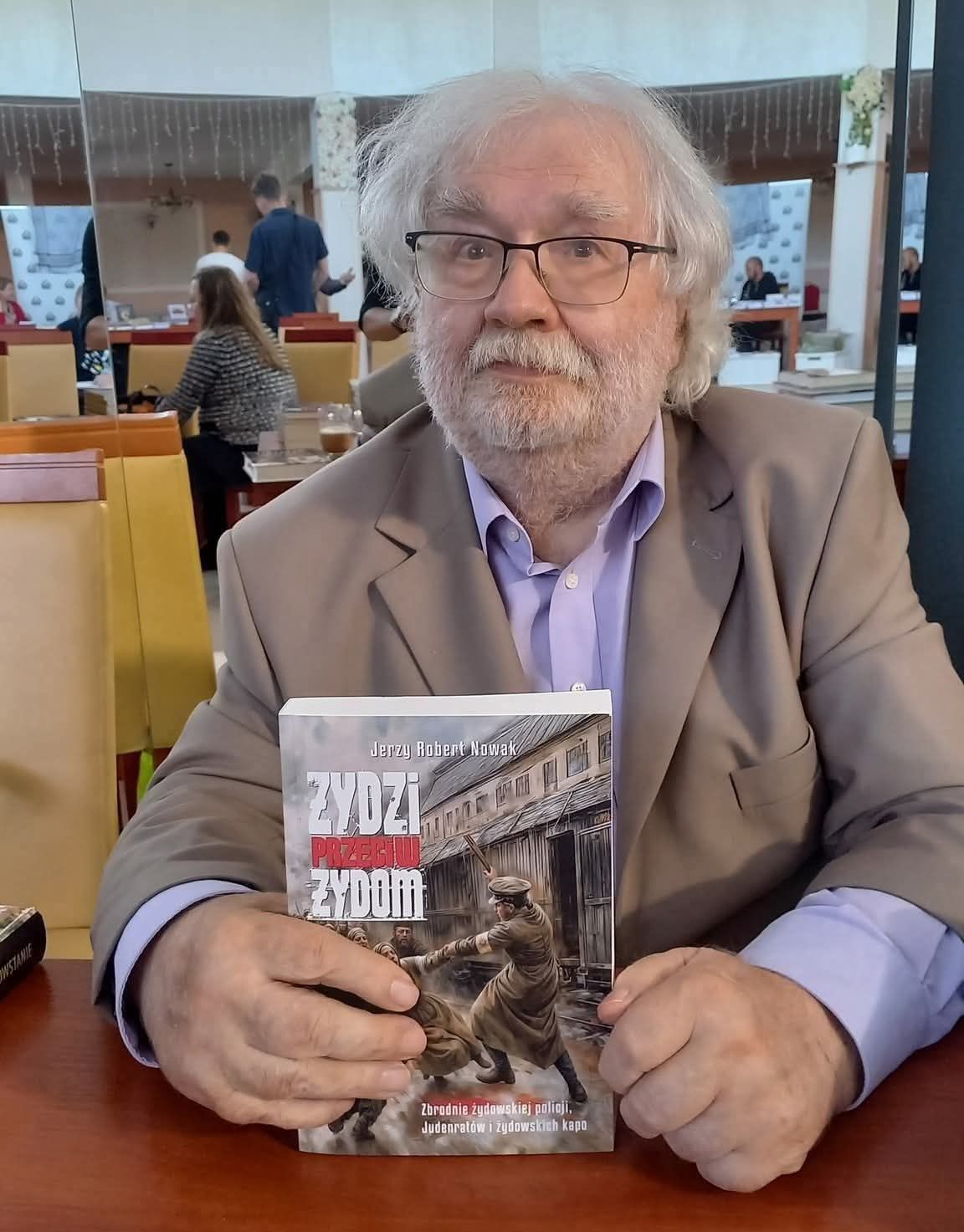 Buy a large book by prof. Jerzy Robert Nowak on judaic Crimes – HERE
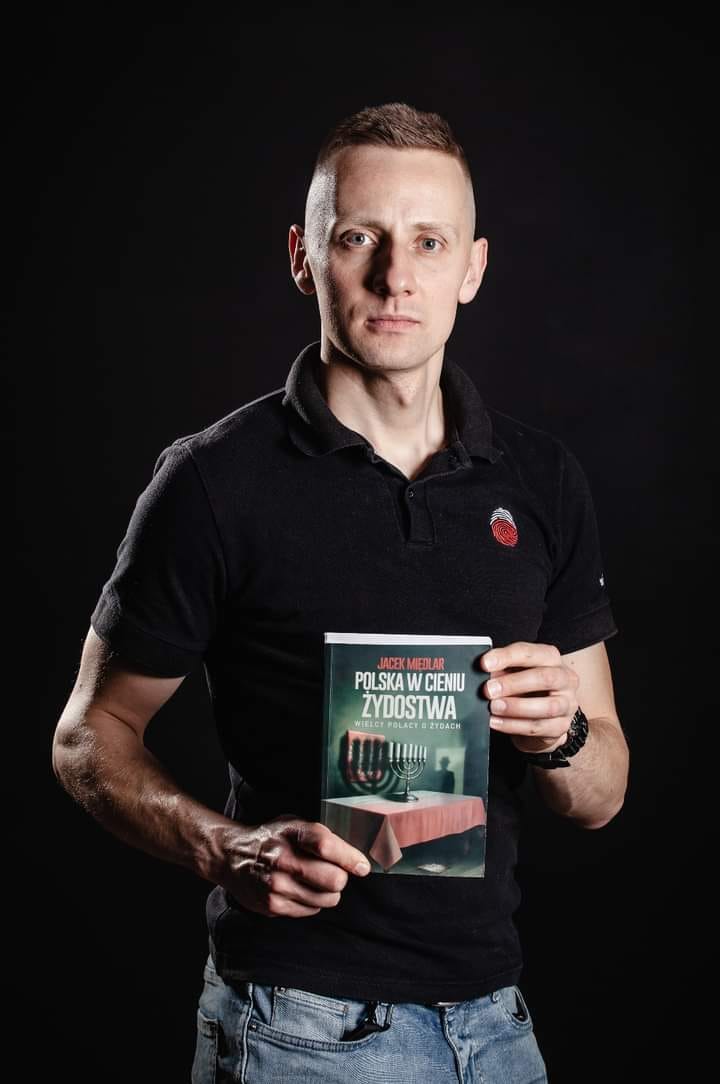 Read the book “Poland in the Shadow of Jewry” – https://sklep-wrawo.pl
Read also:
What can be the success of Jack Międlar's “Neighbours”?









![Ostrołęka ma dwóch nowych prokuratorów. Nominacje odebrali z rąk Żurka i Korneluka [ZDJĘCIA]](https://www.eostroleka.pl/luba/dane/pliki/zdjecia/2026/fad63e92-3c7d-48a8-8cc8-8b4259c570e4.jpeg)