For more than 2 decades, after the withdrawal of Concorde aircraft, commercial supersonic flights over land were banned due to devastating noise. NASA has just taken a large step to solve this problem forever.
Their experimental X-59 jet broke the sound barrier, turning a powerful bang into a muffled sound, resembling slamming the car's door from about 6 metres away. If the U.S. tests succeed, the time of intercontinental travel may be reduced importantly in the coming years.
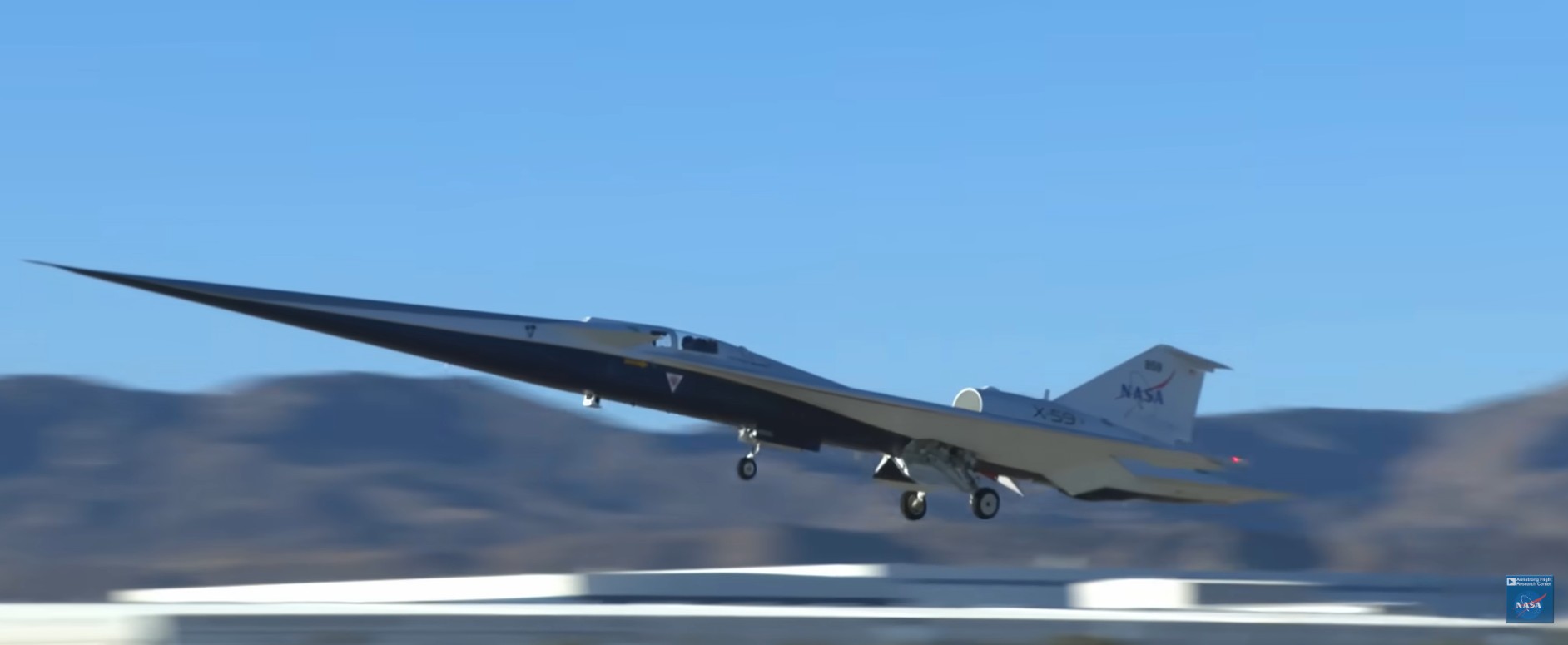
Experimental aircraft Lockheed Martin X-59 Quest took its first supersonic flight on 5 June 2026, reaching Mach 1.1 velocity at 43,400 feet (near 13 km). A week later, on June 12, the device had already expanded to Mach 1.4, flying at a ceiling of 55,000 feet (about 17 km). The most crucial thing, however, is not the velocity itself, but a unique plan with an almost 30-meter fuselage, a 3rd of which is simply a disproportionately long, narrowing nose.
NASA X-59 took the first flight. To reconstruct supersonic travel over the land
No more crackling windows.
The task of an elongated beak is to break the shock waves and prevent them from joining into 1 powerful sound thunder. The appropriate distribution of shock waves along the hull makes the atmosphere weakens smaller waves, blurring fast force changes. As a result, only a deaf sound or sound can be heard on earth. The device is intended to make sound at the level of only 75 decibels, which is simply a technological gap compared to 105 PldB (i.e. Perceived Level of defibels; special measurement utilized in acoustics and aeronautical engineering. It differs from standard decibels (dB) due to the fact that it does not measurement only physical, dry sound pressure. PldB takes into account how the human ear and tense strategy actually receive a sudden, powerful bang, commonly known as a sonic thunderstorm), with legendary Concorde shaking windows in buildings.
Supersonic ‘Frankenstein’ without windscreen
The engineers went to many interesting plan compromises, creating a circumstantial technological “Frankenstein”. The device uses ready-made components from well-known military machines: the chassis comes from the F-16 fighter, the throttle from the F-18 deck, and the control rod straight from the invisible to radar bomber F-117. In turn, Rockwell's avionics strategy Collins Pro Line Fusion was borrowed from the turbo-propeller aircraft Beechcraft King Air, which in the future will facilitate the movement of an innovative device in civilian airspace.
However, the top challenge for test pilots alone remains the full deficiency of windscreen. Instead, the pilot uses the eXternal imagination strategy (XVS), which is based on 2 advanced resolution cameras placed outside the hull. The image is displayed on a powerful, interior 4K monitor, enriched with precise flight data in the form of an expanded reality (AR). It turns out that the technology is doing large – thanks to advanced image processing, the pilots utilizing the XVS can see another machines in the air much faster than doing it through a conventional window.
U.S. tour and change of the law
The success of Edwards is only the beginning of a long road. After completing the second phase of rigorous acoustic tests, in late 2026 NASA plans to ship the X-59 jet into a national tour across the United States. The aircraft will fly over diverse demographic cities, and the agency will scrupulously gather opinions from local communities about the level of sound generated, which will vary from 70 to 90 PldB depending on the maneuvers.
The data collected will go straight to the national Aviation Administration (FAA) and the global civilian Aviation Organisation (ICAO). The main nonsubjective of American officials is to get technological evidence that will let the abolition of the ban on supersonic passenger flights over land, which has been in force continuously since 1973. However, before civilian jets re-emerging the sound barrier appear in the sky, the manufacture will gotta prove not only the silence over the heads, but above all the financial viability of specified machines.
If article Supersonic flights return to land. NASA successfully tested the silent X-59 jet does not look right in your RSS reader, then see it on iMagazine.