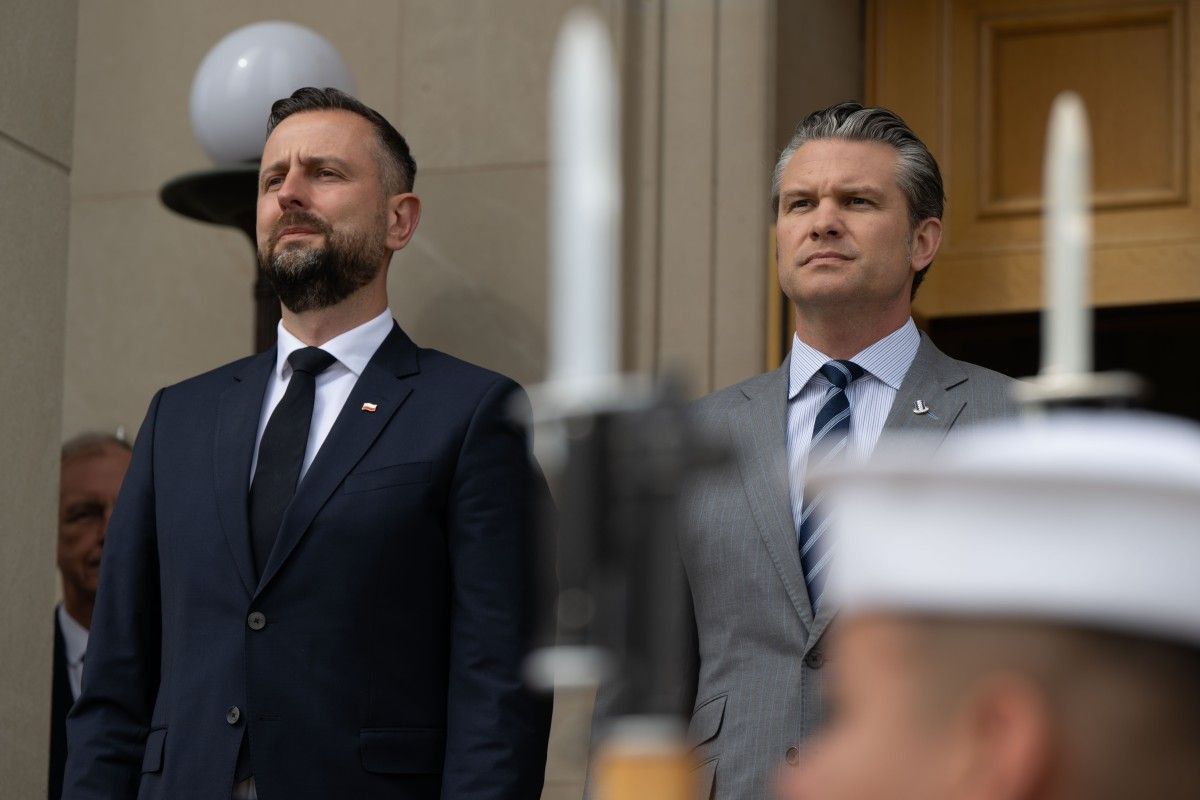
We are obliged to remember the graduates of our school who gave their lives for their free homeland and who were brutally murdered in the Katyń Forest," said Deputy Prime Minister Władysław Kosiniak-Kamish, revealing the plaque dedicated to the graduates of the King Jan Sobieski advanced School, victims of the 1940 Katyń Crime.
The 2nd King John III Sobieski advanced School in Krakow is 1 of the oldest advanced schools in the capital of Małopolska. It's been 142 years. The current advanced school is simply a continuation of the pre-war King Jan Sobieski advanced School, which was founded on the 200th anniversary of Vienna's rescue – in 1883. Since then, the school's gates, after their successful graduation, have been abandoned by graduates, many of whom have written down the glorious and beautiful charters of service to their homeland—civil, social, and military. Among them, as Dr. Marcin Sporna, a historian and past teacher at the Second advanced School, 72 became victims of the Katyn crime. It was thanks to the investigation and efforts of Dr. Spornny, Deputy Prime Minister and Minister of National Defence, as well as the postgraduate of this school Władysław Kosiniak-Kamysz, who present unveiled a plaque on the walls of the school with names of the Soviets murdered.
Apart from Deputy Prime Minister Władysław Kosiniak-Kamysza, Aleksander Miszalski, president of Krakow (also a postgraduate of this advanced school); Lech Parell, Head of the Office for Combatants and Represented Persons and Izabella Sariusz-Skępska, president of the Federation of Katyń Families took part in the ceremony in II LO.
Deputy Prime Minister Kosiniak-Kamysz stressed in his speech that among the murdered graduates were prominent representatives of the medical and legal professions, scientists, pedagogues and the military. Almost everyone was connected by the fact that part of their career was military service, and many began their way of life by fighting in the Legions of Chief Joseph Piłsudski. “We do not cultivate memories of Katyn to scratch wounds, nor is it hateful memory. This is simply a poignant memory, a informing memory – Kosiniak-Kamish said. – After all, the threat inactive flows from the same side – from the Kremlin, from which the order was issued to execution our officers in Katyn, the elite of the Polish nation. They tried to destruct the immortal spirit of our homeland. It was a failed attempt, but 1 must remember that it was taken," added the head of the MON.
Faithful curse to the End
Let's at least bring up a fewer names on the exposed board.
Colonel Władysław Konrad Czapliński – legionary, bachelor of the Order of Virtuti Militari, commander of the 27th Infantry Regiment in Czestochowa from 1930 to 1936. At the time of the outbreak of planet War II at rest, he was arrested by the NKVD in 1940 in Delatyna. His name is on the Ukrainian Katyń List.
Prime Minister Jan Dunin-Brzeziński, cavalryman, commander of the 2nd Ulan Regiment in Legions – organized this regiment in the Polish Army, later named the 2nd Rokitniaski Szwolezer Regiment. After the Polish-bolshevik War, he moved to the reserve and became mayor of Myślenice in 1934. planet War II found him in Lviv, where after the Soviets occupied the city he was interned by them. It is assumed that he died in April 1940, murdered by the NKVD in Mednoje.
Colonel Adam Mastaw, doctor of medicine, his military career was mainly connected with the 5th territory infirmary in Krakow, where he served as chief of staff. After russian aggression against Poland on September 17, 1939, in unknown circumstances, he was taken prisoner and imprisoned in a camp in Starobielsk. In the spring of 1940, murdered by the NKVD in Kharkiv.
Prime Minister August Nowosielski, soldier of the 1st Polish Legions Infantry Regiment, bachelor of the Order of Virtuti Militari for the conflict of Kostyuchnówka, head of the Secretariat of the Regulatory Commission in the General Inspectorate of the Armed Forces, in September’39, commander of the 77th Infantry Regiment, after entering russian captivity was murdered in Katyń between 13 and 14 April 1940.
Lieutenant-Rez. Andrzej Rieger, cavalry in the 12th Ulan Regiment, Doctor of Law and Prosecutor. After the war broke out in 1939 as a reserve officer, he tried to get to the reserve point of his regiment in Volyn. On September 17, he was arrested by the Soviets and imprisoned in Kozielsk. Murdered in Katyn between 23 and 24 April 1940.
Major dir. Marcin Zieliński, bachelor of the Order of Virtuti Militari, prof. of medical sciences, neurologist and psychiatrist, lecturer at the Jagiellonian University, medical consultant in the most celebrated court proceeding before the war, the alleged Gorgon case. On September 17, 1939, russian captivity was captured under unknown circumstances. He was imprisoned in Kozielsk, murdered in Katyn between 9 and 11 April 1940.





![Od pustyni do Starlinków. Jak zmienił się dżihadyzm? [25 LAT PO 11 WRZEŚNIA]](https://cdn.oko.press/cdn-cgi/image/trim=178;0;190;0,width=1200,quality=75/https://cdn.oko.press/2026/09/AFP__20190909__1K16Q6__v2__HighRes__ReportageSurDesPersonnesAtteintesTardivementDeCa.jpg)