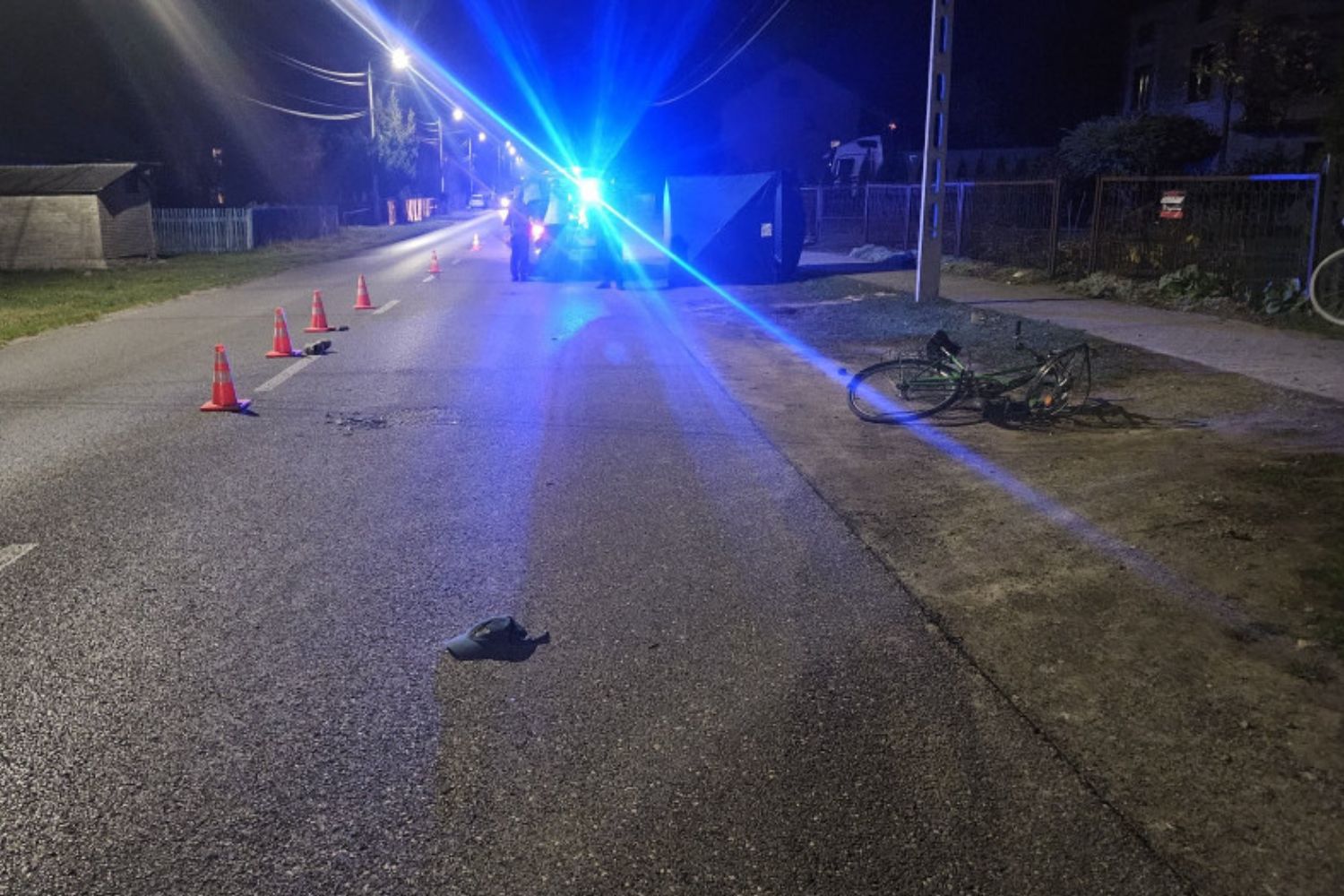
Machete, knives, castet, telescopic baton – this is part of an arsenal of dangerous items that police officers found in the flat of a 16-year-old in Wola, Warsaw. According to the service, he was to prepare the killing of many people.
Wave of attacks by teenage knifemen
This time the tragedy was avoided, in contrast to the wave of bloody attacks that occurred in Polish schools in the last 2 weeks. As a result, a full of respective students, teachers and educational staff were injured and 1 individual died. On Thursday, the knife was attacked at noon in the very centre of Warsaw. It was besides loud about arresting a man who was expected to attack police officers under the seat of the Constitutional Court. A knife was found on him.
The specified possession of a knife, however, cannot in rule be the basis for criminal liability. In another words, in Poland, carrying a knife in public places is not punishable, although regulations restrict its possession in circumstantial situations.
Pursuant to Article 50a(1) of the Code of Offence, the punishment of detention, regulation of liberty or fine threatens to carry a knife, machete or another dangerous object if circumstances indicate intent to usage it to commit a crime. Besides, the punishment is besides for having a knife by the participants of mass events.
Although the discussion of changing these regulations was conducted a fewer years ago, the law allowing the possession of sharp, dangerous objects in public space remains valid.
Scissors allowed
Prof. Tomasz Safjański, Deputy Head of the Centre for Cross-border safety investigation and erstwhile manager of the Interpol National Office, is the reason why these provisions are being strengthened. In an interview with the “Rzeczpospolita” he proposes to introduce a ban on carrying a knife or object of sharp end in a public place for no good reason. – The model can be British regulations, which alternatively of unrealistic ban on knives in general focus the attention of uniformed services on checks, whether it is nonsubjective for citizens to have sharp tools, specified as knives, bayonets, axes in public space – explains Prof. Safjanski.
He explains that, according to his proposal, having an offensive tool in a public place, specified as a knife or sharp-cut object, would be a crime, unless the individual has a legitimate reason or there is an nonsubjective reason for it.
– It's crucial to reverse the burden of proof. It is not the police who request to prove that the bear had bad intentions, but it is the knife holder who must convince the law enforcement or the court that the reason for bringing it was justified in a given situation," the expert says.
It states that there should be exceptions to the general prohibition, e.g. for pocketknifes, i.e. folding knives up to 3 inches long (approx. 7.62 cm). In his view, it should besides be justified to carry the tools essential for work, specified as professional cook knives or construction tools, if the circumstances, way and time of movement indicate their usability. The protection should besides cover legitimate spiritual and cultural traditions, taking into account the principles of safety and applicable restrictions.
Specific protection of pupils
It indicates that the provisions should supply circumstantial protection for educational establishments. This means that his proposed ban on knives must be absolute in schools.
– An effective safety policy requires more than a ban. In England, knife regulations work within a wider strategy of legal and preventive measures. For example, there are voluntary knives to reduce the number of dangerous objects in circulation. Restrictions on sales to minors and age verification mechanisms for online purchases are crucial – says Prof. Safjański.
Discussion needed
Maciej Zaborowski, a defender of R., who murdered the worker of the University of Warsaw with an axe, refers to these proposals. As he stresses, he advocates a reasonable regulation on the possession of dangerous knife-type objects in public space.
– I think it is worth discussing this issue extensively, due to the fact that the problem of committing crimes with knives exists and it is worth looking for effective solutions. In any European countries, however, prohibitions and restrictions are effective, frequently successfully. It is besides worth to regulate this problem in Poland, but wisely – the lawyer argues.
The expert is besides negatively assessing the thought of supplementing the penal code with a ban on knives for no good reason.
– I'm very skeptical about this kind of ban. My top doubts arise from the reversed burden of proof proposed by the professor, according to which it is the holder of the sharp object who will gotta decently justify his possession in a given situation. After all, in Poland the primary rule is the presumption of innocence, not the presumption of guilt. I believe that the enforcement of specified a prohibition would in practice affect many pathologies and would simply be ineffective. Citizens in different everyday situations would gotta explain themselves, not always successfully, why they have a sharp object. This would enter civilian liberties besides far – concludes Mr Zaborowski.
Attempts to make changes have already been
Attempts to tighten the rules on the possession of sharp objects have already been made. In 2011, the PiS came out with a task prohibiting the wearing in public places of objects with a blade dimension exceeding 8 cm. However, the government has not been passed.
Ineffective were besides the interpellations submitted more than a year ago. In 1 of them, PiS associate Violetta Maria Kulpa advocated the introduction of a ban on the wearing of knives with a blade dimension exceeding 6 cm. A non-attached MP, Adam Gomoła, proposed a ban on knives with blades longer than 12 cm in public.
Opinion for ‘Rzeczpospolita’
Michał Gabriel-Węglowski
Prosecutor, associate of the codification committee
I'm skeptical about the general ban on knives in public. It doesn't cost anything to pass specified a rule, but what's next? Will the police search all another individual on the street to see if they're violating the ban? If individual wants to usage a knife for a robbery or feels safer with it, they'll inactive wear it. In addition, curious people will start walking with other, no little dangerous equipment. The problem is besides the self-definition of the knife. There's gonna be any inventions that are formally hard to admit as a knife. By the way, I don't think there's a legal definition of this object anywhere. The introduction of the clauses on the legitimate holding of a knife or the exceptions to the ban is even wider in the legal gate to the galimatias. Although I support the ban on specified items in schools, I believe that there is besides a determined knife aggressor to smuggle.
We will never full destruct the threats. Money and time are needed for real safety increases. We request to strengthen and train the police, fill the city with patrols where knife attacks happen more often. The very sight of police and police cars is slowing down many murderous urges. Further, it is besides essential to introduce trained protection to various facilities. Polish education needs to be taken seriously, so that our children and young people are dealt with by the vocation. A essential component is besides the elimination of negligence in the psychiatric care strategy and intellectual support. This would have a large effect, counteracting the radicalisation of young people.
A prosecutor, a police officer, an agent may halt or punish the attacker, but no criminal law can save us in the absence of education and care, good education, and poorness and household pathologies, which are most frequently sources of later tragedy.