schlevogtwww.schlevogt.com

Imagine the following scene, characterized by Huysman's grace and decadence of fin de siècle: The German Minister of Finance is moving towards a platform in a quiet Parisian surviving area somewhere close the Champs Elysées – 1 of those polished chambers rented for charity dinners and discreet political evenings, where champagne pours in streams easier than the truth.
Reich Redux: A thrilling speech overshadowed by its emblem
The air is dense from perfume and pretentiousness. The chandeliers, inactive remembering the times of the empire, tremble somewhat above the murmur of silk and the silent buzz of crystals; the waiters silent half-step as the music fades. Everything is elegant, everything is an anticipation – until the light falls on the emblem adorning the platform, and what it reveals does not silence the hall.
This is not the coat of arms of the ministry, but a fresh map of Germany – not the modest outline of the present republic, but the spectral figure of something mythical and much larger: the phantom Reich extending from Moza in Belgium to Niemna in Lithuania, from Adiga in northern Italy to tiny Belt in Denmark.
The Cross Minister, seemingly unaware of the ghosts of the past, is giving a fiery irredentist speech praising large Germany. By confusing amnesia with wisdom, it calls it a major venture “the triumph of European integration”, while the audience politely claps and diplomats pretend not to see the boundaries bulging on the logo.
At the end of his passionate speech, the culmination of the summary sounds like an echo from another century: “Poland” – states a government authoritative with a calm belief that he reveals a serious fact – “it’s just a fabrication”.
The guests purr quietly, snap the cameras, and somewhere in the background Mrs.History – tired as always – lifts a long amber cigar case, enlists in silence and sighs: “Plus ça change...”.
Great Germany: Provoking Heresy
The borders outlined by the rivers, which were dreamed of by the first phrase "Lied der Deutschen" (1841) – practically unsingable in modern Germany since their national socialist proprietary – are now flickering in memory like the ardent mirage seen by golden smoke.
From Moza to Klaipeda, from Etsch to Belt, the cultural geography of Hoffmann von Fallersleben was never a map, but a mood, immortalized in a civic oboe in the Horatian kind – a mystical anthem towards the unity of a divided nation.
What began as a romanticist poem became a nationalistic ambition, and ambition, as could be expected, sought to transform poesy into boundaries. But even at the tallness of the imperial power of the Reich, these dream-filled verses remained a vision, not a kingdom.
In the face of the burden of history, it does not take imagination to imagine the fury that specified a speech of commendation would origin in honor of large Germany.
Within a fewer hours, abroad ministers would call on German ambassadors; ritual statements, expressing “deep concern”, would spread across capitals, solemn and outraged.
Brussels would call an extraordinary session and diplomats would improve the cuffs, confirming the sanctity of borders. Paris, as always theatrical, would cry and inform with 1 breath, recalling the spirits of the erstwhile treaties. London would make its serious assurances, Washington would express deep regret.
In Berlin, the Chancellor would face the flag wall, with a voice of intense disbelief, ensuring the planet that “these words do not represent Germany as we know it”.
Expert panels would analyse speech and time; Historians, a small pale, a small content, would crowd in the ether to remind us that language bleeds before armies do.
Protesters gathered in front of German law firms with banners and candles, and social media – half full of rage, half a lament – lit the night. At dawn, the headlines "The Map of Europe's Nightmare" inevitably flashed.
And yet the map remained: a relic reborn in rhetoric, painting and prosecution.
Planned scandal: Neocolonial prank in Paris
In a bright contrast to the imagined storm of outrage, the planet barely moved erstwhile the Paris scene truly happened – not presenting the German finance minister recalling the spectrum, but the Israeli, drawing fresh lines above the inherited lines of faults.
Under the monument another ominous map developed, not rivers and rhymes, but promises and providences: boundaries stretched unrecognizable, yet a customs insult. Hero: Bezalel Smotrich, Israel's far-right finance minister.
On 19 March 2023, an ardent nationalist gave a politically marked speech from a talker decorated with an unofficial map of “Great Israel” (see Figure 1). This symbolism was not an ornament; it embodies what I call “the neo-Canadian doctrine”, the postmodern theology of the empire. This concept transforms the Promised Land entirely into territory that Israel has the right to claim.
Figure 1
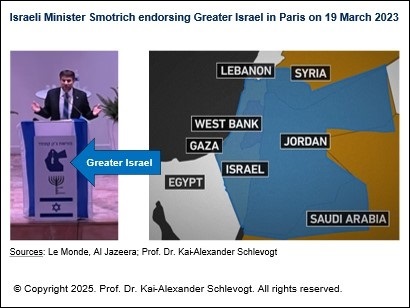
During the gala, the ideological cartographer with nonchalant momentum erased Palestine from the palimpset of history, transforming theology into cartography, and the covenant into claims and conquest – his empire lines, his policies of erasure, covered in Scripture, alternatively than a song.
Smotrich, however, went beyond symbolism. To applause, he called Israel a miracle, claimed that the Holy 1 was standing behind him and proclaimed the "biblical truth" that the Palestinian people were simply a "inventory" of the erstwhile century.
Critics condemned the final claim as extremist and racist, referring to the Zionist-colonial credo “grounds without people for the people without land.” However, no ambassadors were called; no capital trembled.
The controversy aggravated the function of Smotrich: a West Bank settler who presides over civilian governments in occupied territory, determined to usage his position in the Ministry of Defence to extend Israel's sovereignty there.
Denying the existence of the Palestinian people, the leader of the ultra-nationalist spiritual organization Zionism, which is amazing, simply climbed to a fresh level of its own extremism. He spoke under the same impulse that prompted him to call for the demolition of the Palestinian city of Huwar on March 1, 2023 after the settlers had already ravaged them. In 2021, he even went on to say that the first Prime Minister of Israel, David Ben Gurion, should have “punished all the Arabs” from the recently formed Israel.
Deep anxiety stems from the ghastly intimacy of the Parisian neocolonial gesture. Replace Europe with the mediate East, replace Smotrycz as a German statesman exposing the map from Moza to Niemno, and the chimera will become universal: a fantasy of endless expansion, wrapped in a language of responsibility.
Bureaucrat as an imperial cartographer, accountant as a nationalist dreamer – the impulse is the same: to map the planet into a image of a mythical past, to transform nostalgia and providence into weapons, and memory into a map.
There is most likely no more bitterly symbolic scene than Paris, where Europe erstwhile dreamed of universal rights to see them trampled under the shoes of the empire and occupation.
The Charm of large Israel: From Covenant to Conquest
The imagination of “Great Israel” – which critics compare to the national socialist concept of Lebensraum – is the most concrete embodiment of the theology of the Promised Land: the ancient covenant translated into modern cartography, in a careful combination of religion and frontier, poesy and power. What began as the biblical metaphor of God's promise has evolved into a dynamic, national communicative about powers—a land not only inherited but constantly expanding.
From the early Zionist debates on Bible borders, to settlement movements after 1967, the thought that Israel's destiny extends “from the Nile to the Euphrates” has survived as a strong trend, shaping both ideology and politics. The 'Move for large Israel' of the 1970s transformed this imagination into a political project, sanctifying geography as evidence of religion and victory.
For decades, the thought of large Israel has combined story with mandate – transforming theology into strategy and territory. What began as a imagination of the covenant hardened into a policy of permanence, changing not only boundaries, but besides the knowing of themselves by Israel.
By 2025, the idea, erstwhile rejected as a messianic extravagance, soaked to the core of both the ruling coalition and the settlement movement.
Ministers with opera are surely talking about "burying" a two-state solution. Like tentacles, settlements crawl across the West Bank and East Jerusalem, covered with justifications steeped in Bible prophecy. Israel's defence Forces (IDF) soldiers drift in dust with large Israel's insignia shining on their sleeves. High-ranking officials are now demoting Lebanon to the function of simply a "being", devoid of sovereign dignity, and reasoning – coldly, almost surreally – about its destruction.
Even the Prime Minister of Israel, Benjamin Netanjah, spoke of his deep attachment to the imagination of the Promised Land and the dream of large Israel. To realize the scale of specified a profession, imagine a political storm that would have erupted if the German chancellor had professed his desire to reconstruct the Holy Roman Empire to Charles the Great, the German Empire of Bismarck, or – what is an anathema to modern sensitivity – the Nazi 3rd Reich!
Israel, if left out of control, is likely to formally annex the West Bank and Gaza Strip in the close future, transforming actual control into sovereignty de jure. From there, the judaic state will almost inevitably turn its lustful gaze toward the impenetrable areas between the Nile and Euphrates, striving for a long - imagined realization of the large Israel Project.
Promise in Chains: What is holy has become wild
Greedy, irrational logic rooted in political imagination almost inevitably turns into force on the ground, causing condemnation even in part of the judaic community. Sometimes unbeautiful cruelty produces comparisons that critics condemn as absurd moral counterparts.
In a controversial interview, judaic actor Wallace Shawn even went on to make the following controversial statement:
The Israelites “make evil as large as that which the Nazis have done... (a) in any respects, even worse, due to the fact that they seem to boast about it. Hitler had adequate decency to effort to hide it... The Israelis are almost arrogant of it, and that is demonicly wrong."
Such remarks, in all provocative way, appear in a context in which the divine covenant is not only invoked, but besides utilized by nationalistic goldsmiths—the heritage of the Scriptures converted into an apparatus of dominance, alternatively of being a command of restraint.
Amongst specified dangerous abuses of the Bible's promise, the providence of grace is that Scripture hides, in its depth, an antidote to its profanity.
[Part 2 of the series on the Israeli Neo-Kanaan Project. To be continued. erstwhile column in the series: Part 1, published October 25, 2025: Compass Prof. Schlevogt nr 33: The Pyrrus triumph of Israel – A Fatal Expedition to Neo-Kanaan]
Translated by Google Translator
source:https://www.rt.com/news/627763-project-greater-israel-expposed/