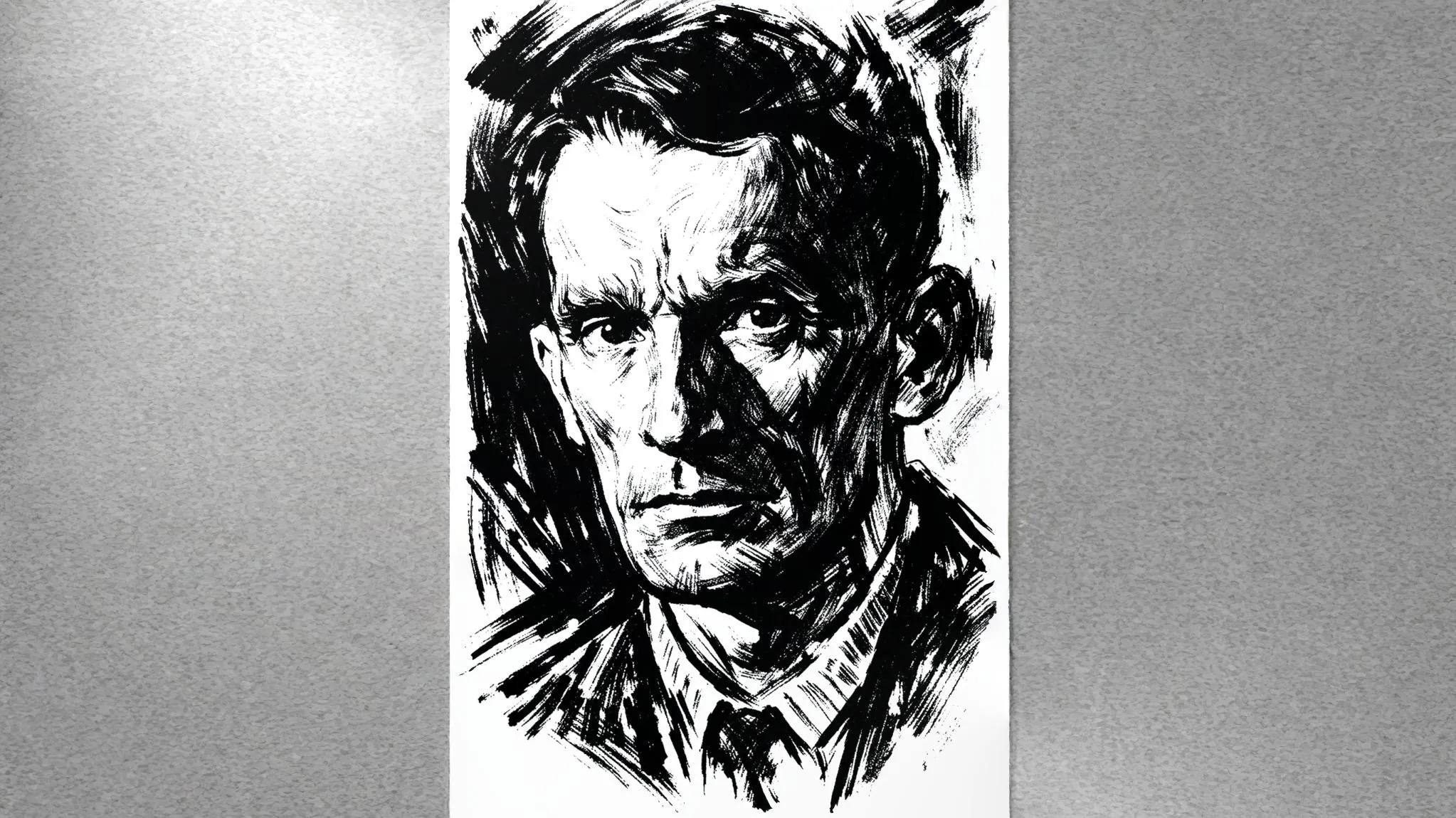
Information Agency: The year 2026 was announced in Poland by the Year of Sergiusz Piasecki, on the occasion of 125th anniversary of his birth, after his body was brought to Poland in 2025. This decision was made by the Sejm of the Republic of Poland on 26 September 2025. Now the Club of Cultural Publications of the Association of Polish Journalists invites to the lecture "Sergiusz Piasecki (1901-1964) – a soldier, writer, patriot" is the subject of the lecture, which Marek Jończyk from the Delegation of the Institute of National Memory (IPN) in Kielce will give.
Home
Sergius Piasecki is simply a prominent writer, smuggler, soldier and declared anti-communist, symbol of the fight against totalitarianism, he was honoured by the Sejm of the Republic of Poland on the 125th anniversary of his birth (1901) and more than 60 years after his death. It is simply a picturesque but controversial figure. Sergius Piasecki was known for his different biography – he worked for Polish intelligence, was a prisoner, and in his books he realistically described life on the border of the Second Republic of Poland and the Union of Socialist russian Republics (now the Russian Federation) As part of the Year of Sergius Piasecki, exhibitions (e.g. "Seven faces of Sergius Piasecki" in London) and ceremonies related to his postwar biography were planned.
Sergius Piasecki (1901-1964) – soldier, writer, patriot
The Cultural Publications Club of the Association of Polish Journalists invites to the lecture "Sergiusz Piasecki (1901-1964) – a soldier, writer, patriot" is the subject of the lecture" which he will give Marek Ionian from the Delegation of the Institute of National Memory (IPN) in Kielce. The event will be held in Wednesday, March 4, 2026, at 5 p.m. in the Journalist's home (3/5 Foksal Street in Warsaw). The discussion will be led by Dr. Teresa Kaczorowska – president of SDP Cultural Publications Club.
Sergius Piasecki – basic information
Sergei Piasecki, Pseudo. (Army conflict Union, National Army) “Kira”, “Conrad”, “Suez”, writer, smuggler, soldier and declared anti-communist, symbol of the fight against totalitarianism was born on 1 April 1901 in Lachovich close Baranovich. He was the illegitimate boy of the ruined Polish nobleman Michał Piasecki and a servant, Belarusian peasant of Klaudia Kukalowicz.
Sergius Piasecki – childhood and youth
Sergius Piasecki attended Russian gymnasiums in Minsk, Bobrujsk, Włodzimierz on Klazma and Pokrow as a child. He was in Moscow, where he witnessed the revolution and the death of his friends. At that time he gained an aversion to the Bolshevik ideology. In 1919, in Minsk, he collaborated with the occupying city, Polish troops. He fought in the ranks of the Polish Lithuanian-Belarusian Division. He graduated from the Podchorzech Infantry School in Warsaw and took part in the Polish-bolshevik War (war of the Second Polish Republic troops with the Red Army of the russian Socialist Republics, now the Russian Federation). He fought for Warsaw in 1920. It was demobilized on 12 May 1921.
Sergei Piasecki – agent and smuggler
After the war, Sergei Piasecki wandered through Vilnius, having various, frequently illegal activities. In August 1922 he became an intelligence agent of the Second Republic of Poland. According to the opinion of the superiors of the Second Branch of the Polish Army, showed ‘brave courage’. He's advanced to Lieutenant. He besides struggled with smuggling, which repeatedly justified his spy work. As a result, he became addicted to drugs, which became the origin of his problems. He was arrested after clashing smuggling gangs and imprisoned in prison. Consequently, he was expelled from the interview in 1926. He took care of robberies. Under the influence of drugs, he assaulted, under Grodna, with a revolver, the buyers. For his participation in the robbery, he was sentenced to an ad hoc field court in Vilnius, on January 9, 1930, sentenced to death penalty. In favour of intelligence, he was reduced to 15 years in prison. The punishment was carried out in Rawicz, Koronów and yet in the heaviest prison in the Second Republic of Poland – on the Holy Cross, in monastery buildings on Lysa Góra, replaced by the authorities of the Russian Empire, and later utilized by the Polish Łwaga as a criminal establishment, with increased security, called “Polish Sakhalin”.
This is how “Big Bear's lover” was born
In prison, Sergei Piasecki began to read the Bible and the weekly magazine “Literary NewsIt’s okay. ” And he started writing himself. The novels were then written: “Fifth stage” and “The life of the disarmed man” ( first title “The Way Against the Wall”). However, prison censorship stopped them. The freedom and fame of Sergius Piasecki brought the 3rd fresh “Big Bear's lover” which was translated into 16 languages. In the summertime of 1937, Sergei Piasecki was conditionally released as a consequence of the act of grace of Ignacy Muscicki – president of II Republic of Poland. He was released on 2 August 1937.
Sergei Piasecki – planet War II
In September 1939, Sergei Piasecki was assigned to the Border defender Corps. During the war he was in Vilnius. He was an underground soldier, first the Armed Forces Union, and then the National Army, in the rank of lieutenant. He commanded a peculiar division to execute death sentences handed down by underground courts. He besides wrote articles for underground press, including “Polish Fighting”.
Sergius Piasecki – emigration
After planet War II, Sergei Piasecki, after the russian Socialist Republics (now the Russian Federation) occupied Poland for a year. He hid from the safety Office (communist political police operating in Poland from 1944 to 1956, set up to "perpetuate popular power" and destruct social resistance, was subject to the Ministry of Public Security, UB was liable for repression, torture and execution against the independency underground and opposition). Sergius Piasecki threatened by arrest, utilizing changed names, he went to Italy through the Socialist Republic of Czechoslovakia and Germany. He found support in the Second Polish Corps and as his soldier left in the fall of 1946 with a military ship from Naples to Glasgow, Scotland (United Kingdom of large Britain and Northern Ireland). He moved to Hastinhs in 1953. He lived very modestly, earning a surviving in physical labor.
Sergius Piasecki – Literary activity on emigration
In 1947 he became a associate Association of Polish Writers in Foreign. On emigration he wrote a lot, among others, playing his prison books retained by censorship. He was besides a political journalist. He collaborated with the Polish emigration press: the London paper “NewsIn the United States of America, with magazines “Journals of Poland” and “Polish Weekly‘, in France, by the letter ‘National’, in the Swiss Confederation ‘UndercurrentIt’s okay. ” He besides wrote "Diaries". In the Olsk People's Republic, since 1951, all his works were subject to absolute censorship and were withdrawn from libraries.
Sergius Piasecki – death.
Sergius Piasecki died on 12 September 1964, of cancer, at a Polish infirmary in Penley (Wales) and was buried at Borough Cemetery in Hastings. Sergius Piasecki's body was brought to Poland and on 29 September 2025 his ceremonial ceremony was held at the Military Cemetery in Powązki, Warsaw.
Books that Sergius Piasecki wrote
Books that Sergius Piasecki wrote:“Fifth stage“ — an autobiographical fresh about the work of an intelligence agent in the border (written in the prison in April 1934, first printed in 1938, the Publishing Society “The swarm”), “Big Bear's lover“ — a description of the lives of smugglers on the Polish-Soviet border (written in the prison in 1935, first print in 1937, Publishing Society “The swarm”), “Red Eve” – fresh (written in prison in 1936), “Up against the wall” (also as “The Road to the Wall”) — an autobiography from the years of childhood and youth (written in prison in May 1937), “The gods of the night are equal“ — the continuation of the 5th phase (1938, the Society for Publishing “The swarm”), “A 100 questions on Current Warsaw” — political accrual (published as a brochure: Rome, 1947), “Thief trilogy, about the criminal environment of Minsk Litewski from 1918 to 1919” (Rome, Literary Institute 1946-1947: “The Apple” 1946, “I will see me out the window...” 1947, “No 1 will give us salvation...” 1947), “Seven Lucifer pills” – grotesque about the first years of the Republic after planet War II (London, 1948), “Legend shaker” – a fresh about the business fates (London, 1949), “Red Army officer records” – about the business of Vilnius and Lida, watched by russian military eyes, satyr for russian propaganda, army and state (London, Gryf Publications LTD 1957), “The life of the disarmed man“ — the destiny of the demobilized veteran of the 1920 War (London, B. Świderski 1962; the first version of the song was created in prison in 1935), “Adam and Eve” — the hard love of 2 heroes embedded in the war storm in Vilnius in 1939 (first printed as a press fresh in episodes, 1963), “Tower of Babel“ — years of business and underground combat in Vilnius (both volumes of London, Polish Cultural Foundation 1964), “Man turned into a wolf” — activity in the Kresach from 1939 to 1942, “For the honor of the Organization” — Activities in the National Army from 1942 to 1943
Marek Ionian – historian, educator, worker of the Delegation of the Institute of National Memory in Kielce. He graduated from the Institute of Higher past of the Pedagogical School (now Jan Kochanowski University) in Kielce (1993) and the global School of Holocaust Teaching – Yad Vashem Institute in Jerusalem, Israel.
Marek Jończyk is the author books: ‘Katyń Crime on the inhabitants of Kielce. On the 70th anniversary of genocide” — Kielce 2010 and “Your daddy's in Russia...“ – Lists of Kielce Katyns” (Kielce–Warsaw 2020) and respective twelve technological articles, popular sciences and reviews, mainly on the anti-communist opposition and social opposition in the Świętokrzyskie region in the 1970s and 1980s, the problems of the Cursed Soldiers and Stalinist repression in Poland, and Polish-Soviet relations during planet War II.
Marek Jończyk is athe founder and promoter of many investigation and educational projects, historical training and competitions, Oxford debates, historical and educational exhibitions (including 3 devoted to Katyń Crimes). Author of lessons, expeditions and educational-historical rallies and movie historical reviews and multimedia presentations. Co-author of reconstructions and historical performances, scripts and documentary historical films, and radio broadcasts and tv shows. A associate in the search for victims of the communist repression apparatus and the implementation of rehabilitation programs for those deprived of liberty. associate of committees commemorating historical events.
Thank you for reading the text to the end. We urge another messages on the website www.agency-information.com. We want you an interesting reading. Information Agency
AI Culture DEC March 3, 2026