I was encouraged to compose this article by Mrs Jadwiga B., who wrote a short text: “Why is the fact that it is the neighbours of Poles, or Ukrainians, beastly rezali, who smoked and plundered? OUN, UPA gave the frame, the remainder made the rezunas, neighbors.”
A fewer passages of the account:
‘[z] The Ukrainians lived next door, well, like a neighbour to a neighbor. any went to others. My uncle’s sister married a Ukrainian, and they married and baptized children in [Roman Catholic] church. And it was so that Ukrainians were invited to Polish festivals and Ukrainian Poles.’
“I remembered the time erstwhile the Ukrainian host [...] had a holiday, the neighbouring Pole did not thresh or chop wood in respect of the Ukrainian festival. And this Ukrainian reciprocated to Polish neighbours.”
"And these are the grain they gave and the cattle feed for the winter. 1 Ukrainian comes in and says, «Come on, I've got hay, you'll get a car». A second comes in any time: «You will get potatoes from a mound». And it was flying. But it got worse in a while, it got worse. From another villages, individual came and said that they killed their household in it. The question of who they killed was answered “Lachiw”. They no longer said “Poles” only “Lachiv being” [beat the Lachów]. What is Lachy? We did not realize this.”
APOCALYPSA DAY
Ukrainians were effectively instigated to the crime of genocide. Many church ambons began to preach openly before the war. The antilechic hatred was manifested by the Greek-Catholic metropolitan Rev. Archbishop Andrej Szepcki. After the September tragedy he recommended setting up in all village of Kurhanów-might together with speeches and theatre ceremony ceremonies of the deceased Poland.
Initially, the faithful were called upon to "pick up tares from wheat", in a subtext by tares knowing Poles. The faithful were called upon to “pull the Warsaw garbage out of Ukrainian backyards” and then simply called:” Rizata Lachiw. Axes, knives, forks and another farm tools were frequently sacrificed in incitement to crime, for they were already dedicated. Ukrainian dark peasant mass was highly susceptible to ambon calls.
Some churches kept weapons and ammunition. The churches besides served as a gathering place . There have besides been times erstwhile they were the place of punishment.
The loaves of bread were besides celebrated, serving as scapegoats for the slaughter of Polish co-habitants, carried relayed from the village to the village by alleged "pillars". Often, with the dedication of knives and another tools utilized to kill, a letter was read announcing the filling of Polish rivers and lakes, due to the fact that Ukraine must be clean as a teardrop or glass of water.
The sign of readiness to slaughter Poles in the village was the setting of a cross at the edge of the village. At the cross was a hidden list of people destined to be murdered. After the crime work, the cross was burned.
Terrorists from the OUN-UPA convened agrarian meetings of Ukrainian villagers, at whom the decision was made “pohulaty from Lachama” which meant the full slaughter of Polish residents by Ukrainian neighbors.
Ukrainians knew all step of their Polish neighbours. Furthermore, in order to exterminate Poles more effectively, they were urged to hypocritically stay in the village, erstwhile the only chance of rescue was to flee to the city. 1 of the reasons for specified advanced Polish losses was that the Polish population did not fit into the head of what destiny was intended for them by Ukrainians. That individual would come to their house, rob and execution their full household for no reason. Why? They didn't feel guilty, they didn't do anything wrong. Therefore, they did not want to leave their farms completely. Those who survived the pogroms fled into the woods, into the swamps, hid in the grain, highly exhausted, hungry and maltreated. Often, however, they did not save themselves due to the fact that the forests and fields swept the torturers. After the pogrom, Ukrainian nationalists announced that the robbery was carried out “by mistake” by unknown perpetrators and would not happen again. The goal was one: to encourage the survivors to return. Most returnees were killed the next night Sometimes Ukrainians hid their neighbours or relatives – Poles. But erstwhile it came out, they were murdered without mercy for the heart shown.
My parent mentioned this:” Among this group was Grandma's aunt, Aniel Malinowska and her husband. After leaving the church that August, the Malinowskis set out on their way back from the Prababci yard, which warned against the robbery. By saying good-bye to her family, Malinowski took her by the neck and replied in a good mood: “You, so far I am a calm man and I owe nothing to anyone.” They didn't come home, and there were six children there. The search failed. Only after the first conflict with the uppers on 31 August 1943. , the massacred Malinowski bodies were found. A part of bloody clothing was found on the edge of the forest. They were buried shallowly and cast with leaves. Cut off body parts were brought to Zasmyk and buried in collective graves."
From my mom's memories.
..... After the bandit action in the church of Silesia, the resigned grandpa started burying more valuable things the next day. He would break the boxes, padded them with straw, and dug the land in the backyard in front of the house. grandma began dismantling the home by removing the curtains; they were hand embroidered and put them in the box first. Then a twelve red fox skins, Grandpa, as a hunter, collected them for respective years. any of the sheets were packed, silver-plated cutlery and another finer things and cereals. Of course, everything was robbed by Ukrainian neighbors.
The situation was changing for the worse, and more and more cars full of uppers were circulating, hymn songs and Ukrainian songs were arriving in the evening, and angry rhymed songs specified as "Your Death Will Come" and screams in honor of free Ukraine, Bander, Bander "Chay Alive", "Ukraina ridna mata by being and rizata". The echoes carried ominous words...
... . My household and Polish neighbors spent nights in bushes, in bushes and advanced crops, not undressed. In the darkness of the night, on-calls were held, listening and vigiling. Increased care was exercised, sometimes frozen in motion. They remained defenseless and powerless, with fear of all dawn coming.
It was the fullness of summer, the harvest was coming, and the grain fins gilded with all the shades of ripening looked the most beautiful, especially erstwhile the sun was shining. The orchards besides matured cherries, while the full household already prepared to escape, spent the last, at the same time the longest night in life, a night full of scents and mysterious sounds with fragments of Ukrainian songs.
Not only men but besides women and children participated in the slaughters. They walked with torches and set fire on Polish farms, robbing them to the ground before.
The inspirational origin for hatred and incitement to crime was the ideological indications of the CNS and polarist literature. "Hajdamacy" Taras Shevchenko is an apogee of hatred, antipolonism and anti-Catholicism. The content of the Hajdamaks was included in the book Kobzar. This book was located in almost all home of Rusin-Ukrainian.
Strangely, neighbors-genocide didn't hatred the property of Poles, and the individual papers of their victims. With these papers they later fled to the West. They claimed to be Poles, in accordance with the Ounowski directives, to be as far distant from the scene of the crime and never to be punished for their gruesome crimes.
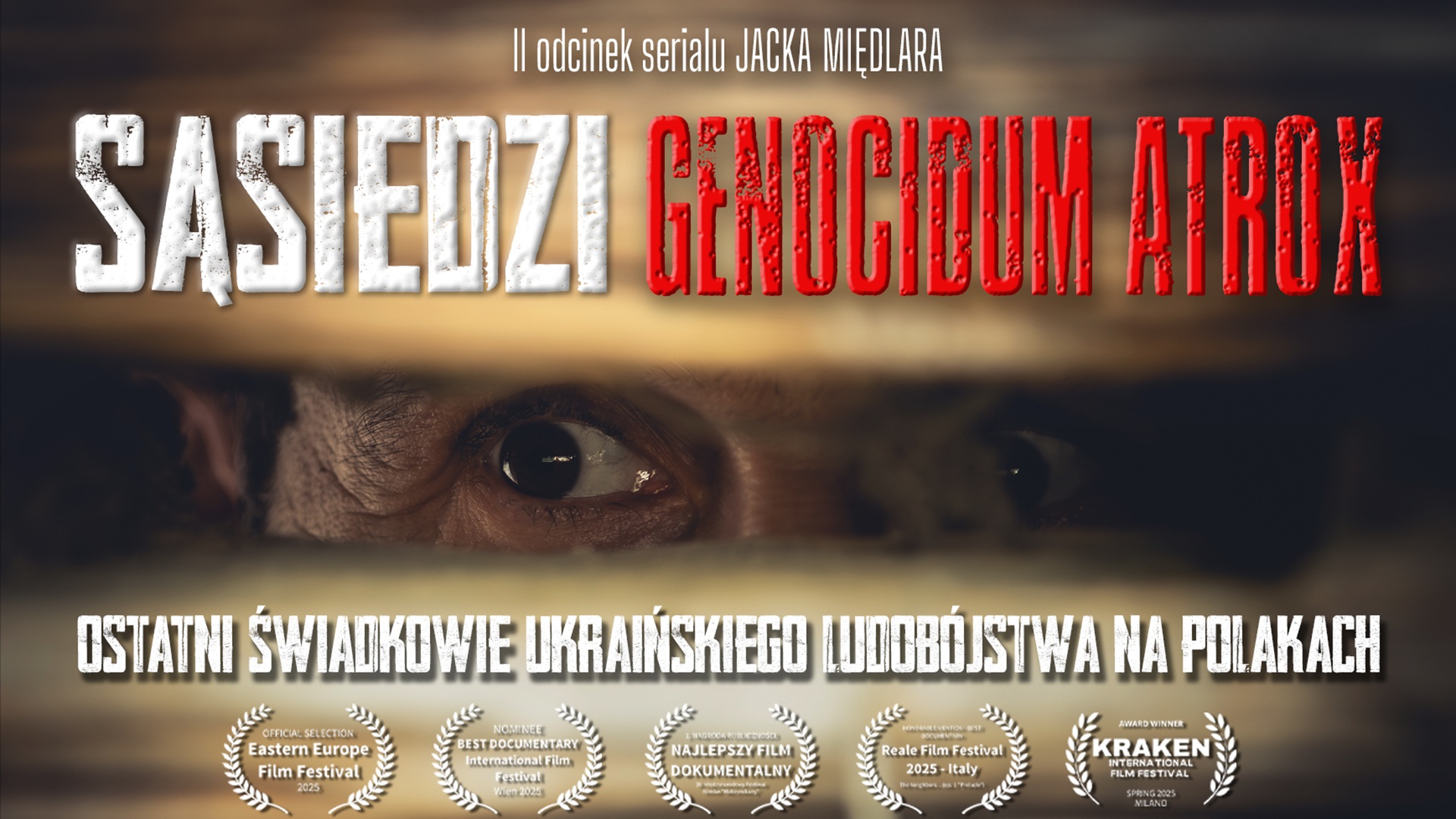
"SYSTEMS" — BOOKS OF JACK METILAR (HERE) AND DOCUMENTAL SERIAL (FilmSasieds.pl)
The books contain an extended introduction of the author, the memories of Volynaks and interviews with Ukrainian Witnesses of crimes in Volyn, Zamość, Podol, east Małopolska (including Podkarpacie). Here we will find comments describing an author’s gathering with a Witness, pictures of Witnesses, and valuable photographs and documents. It is simply a form of a cycle – the author plans further volumes that will deepen the subject. As he points out, the publication is not only a historical study, but besides a "memory of memory" for those who died and those who survived and struggled with trauma throughout their lives.
The series “Neighbours” presents the accounts of fresh surviving witnesses of the Volyn massacre. It's a kind of documentary that shows the suffering-marked scenery of the end life.
The movie has already been honoured 4 times in global movie festivals in Poland, Romania, Italy and Austria. 4 episodes, 8 languages, 1 goal: genocide in the South East Ends.
The title “Neighbours” refers to life in Polish-Ukrainian villages, where people of different nationalities lived in the neighbourhood before the war. The show shows how relations between neighbors could have been brutally transformed by nationalist ideology. The subject of the alleged “axlers” – armed Ukrainian peasants who supported CNS-UPA militias in cultural cleansing is besides discussed.
I know Mr Jack Meatman, and I'm very arrogant of that. He's a titan of labour and an incredibly brave man. He's devoted his life to this project. No state institution has undertaken to implement specified a project, due to the fact that all these institutions operate on the basis of “passive, mediocre, but faithful” politics of the “Polish” government. Jacek Międlar passed the thorny way to make his WORK. He was harassed by the Wrocław D.A., by the ABW and the police who came to his home with a weapon to collect media with Witness interviews and written books. Now no Ukrainian, no flagman and no IPN liar will say that genocide was not. Jack Międlar's work will preserve the memory of those who died as a consequence of genocide, giving them due respect and commemorating their suffering.
Watch episode one. Where to watch episode two? Information in the description or on FilmSasieds.pl




![Ataki w szkołach. Wszyscy dokładamy do tego swoją cegiełkę [KOMENTARZ]](https://storage.googleapis.com/patrykslezak-pbem/plock/articles/image/b66129cb-fb82-4016-bdd4-67d497e57fd0)