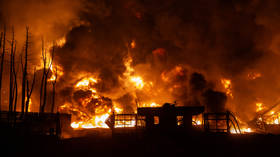
The fire breaks out in Shahran oil warehouse after US attacks and
Israel in Tehran, Iran 8 March 2026
© year Hassan Ghaedi/Anadol for Getty Images
By 19 March 2026, this pattern was unmistakable. What began as a war centered around Israel, Iran, Lebanon and waters around the Strait of Ormuz now has definitely penetrated the infrastructure heart of the Gulf monarchy.
The most established Iranian attack on the Gulf's energy infrastructure is so far a rocket attack on the Qatari industrial complex Ras Laffan, the largest LNG hub in the world, carried out after Israel struck the Iran's South Pars gas field. At the same time, earlier Iranian waves of retaliation have already struck or threatened key nodes on the wider Gulf bow, including the Saudi oil center in Ras Tanura, ports and fuel infrastructure in the UAE in Jebel Ali, the port of Zayed and Fujairah, as well as military and fuel-related facilities in Bahrain. another targets publically mentioned by Iran or discussed in marketplace reports specified as Jubail, Samref, Al Hosn or the Yanbu Red Sea export way are in the second category, where threats, interceptions and partial reports frequently precede complete independent verification. But even in this fog, the strategical message is crystal clear. Iran no longer threatens only the Gulf's energy order. He's investigating how far he can break it.
The logic of these attacks is brutally simple. Gulf Monarchies are rich, technologically advanced and heavy armed, but a crucial part of their economical life focuses on coastal infrastructure, which is hard to hide, completely harden, and even more hard to rapidly rebuild under fire. Refineries, loading terminals, gas separation plants, desalination systems, export bridges, retention farms and energy networks are not abstract resources in the spreadsheet. They are the circulation strategy of the region. Destroying them not only reduces production – threatens electricity, water, transport, state income, insurance markets, shipping schedules and national assurance at the same time. Therefore, the attack on Ras Laffan was far more crucial than a single detonation on the map. It was a signal that the war had crossed the domain boundary most feared by the Gulf ruler – domains where geopolitical conflicts turn into systemic economical paralysis. Reuters and another reports besides show that even intercepted drones and rockets caused fires and interference in Saudi Arabia and the UAE, showing that in this kind of war, partial interception is not the same as security.
Ras Laffan is not just another industrial area. It is simply a jewel in the crown of the Qatari energy model and 1 of the pillars of the planet gas trade. The harm there sounds far beyond Doha. It reaches energy companies in Asia, gas buyers in Europe, oil routes, place prices, inflation expectations and strategical calculations of any government that hoped the Gulf would stay the last reliable ballast in an unordered energy world. The same applies to Saudi facilities specified as Ras Tanura, and UAE export nodes along the Oman Gulf. In the regional war, the discrimination between local harm and global consequences rapidly disappears. Brent approached $110 per barrel after the last escalation, while marketplace and press relations highlighted the threat to around a 5th of the world's LNG supply after Qatar-related disruptions. erstwhile energy infrastructure becomes a deliberate battlefield, prices no longer respond solely to current breaks. They respond to the fear of another attack and then to the fear that repairs themselves can become targets. That's how energy shock is born.
Therefore Israel's decision to decision from decapitation attacks on advanced Iranian officials towards direct attack of Iran's energy base was specified a historical escalation. Israel not only continued to kill high-ranking Iranian officials. On March 18, it besides hit South Pars, the largest gas field in the planet and the core of the Iranian gas system, and related objects around Asaluyeh were besides attacked. South Pars is not any border military warehouse. It is the central body of the Iranian economy and due to the fact that the field is shared with the Northern Qatar Field, an object whose demolition or contamination carries immediate regional and global significance. The Qatari Ministry of abroad Affairs condemned the attack precisely in these words, informing that attacks on energy infrastructure endanger the peoples of the region, the environment and global energy security. In another words, Israel not only expanded the war geographically. She changed the rules of escalation, crossing the boundary of the sphere, about which all actor in the Gulf knows that it can origin consequences far beyond the battlefield.
From that point on, the Iranian consequence was never to stay confined to symbolic retaliation. erstwhile South Pars was struck and advanced Iranian leaders killed at a fast pace, the conflict took on emotional and strategical grammar of existential struggle. The death of Secretary of Ali Larijani's National safety Council was confirmed by the Iranian authorities. Israel besides reported that he killed Intelligence Minister Esmail Khatib, although preliminary reports indicated that Khatib's confirmation initially came more clearly from Israel than from Tehran. Gholamreza Soleimani, commander of the Basij militia, was besides widely reported as killed. Together, the assassinations indicated that Israel was pursuing not only demolition but besides political dismemberment. Under these conditions, Iran's strategy naturally sharpens itself into something like the last resistance, not due to the fact that Tehran abruptly prefers apocalypse, but due to the fact that any leadership under decapitation force begins to reckon that restraint can lead to decline faster than escalation. erstwhile the state feels that its command structure, prestige, economy and deterrence are attacked at once, it starts to act as if endurance itself requires ever-increasing retaliation.
Therefore, it is not adequate to call the Iranian attacks on Gulf infrastructure as a specified revenge. They are besides a doctrine. Tehran says in practice that if you can cut your own energy arteries, no exporter, no refinery, no LNG train, no port or state that has an American power or allies with an anti-Iranian war effort can safely recognise immunity. Warnings issued by Iranian officials and the Revolutionary defender against facilities in Saudi Arabia, the UAE and Qatar were so not rhetorical. It was noted that the set of targets was raised. Even where the missiles were intercepted and where the mentioned sites had not yet been clearly hit, the intention was unmistakable. The aim was to turn the full Gulf energy ecosystem into an emphasis on Israel, Washington and the arabian monarchies, which trust on a functioning hydrocarbon infrastructure for their interior stability. In a strategical sense, Iran went from punishing individual enemies to threatening the architecture of the regional order itself.
There's another cruel layer of this escalation. The Israeli attack on South Pars did not contact only Iran. This besides indirectly hit Iraq, weakening the gas and electricity chain, on which Iraq inactive depends, especially in the field of power generation in the south. Reuters reported that Iran suspended gas exports to Iraq as the war intensified and interior priorities gained in the foreground. This means that the attack advertised as force on Tehran will reflect on Basra, Iraq's energy supply and Iraq's social stability. This is how regional systems break down during the war. The attack on the gas field turns into a deficiency of energy in another country. The rocket in the LNG complex becomes a shipping crisis 2 seas away. The damaged terminal is turning into a political crisis in import-dependent economies, without the right to vote and vote in the war that started the chain reaction. Those who talk freely about limited escalation usually imagine geography as a set of boundaries. Energy systems are subject to different rules. They spread consequences through pipelines, cables, ports, contracts and routes of tankers.
Today, the threat is not simply a wider war in the mediate East. This is the emergence of an active phase of global crisis. erstwhile Gulf export and processing nodes become permanent targets, the global economy begins to absorb shock through respective channels simultaneously. Oil grows, gas grows, transport hazard premiums, insurance increases, inflation expectations increase, central banks lose area for manoeuvre, fragile importers panic and politically polarized societies become more explosive. The attack on Ras Laffan was peculiarly worrying as it hit the symbolic center of LNG trade. Threats to Saudi and Emirati facilities are crucial due to the fact that they endanger backup throughputs, redirection capabilities and the belief that Gulf producers can mitigate shocks elsewhere. The dangers around Hormuz multiply the effect, due to the fact that any cargo that cannot be transported on time causes fear of actual deficiency. This is no longer a conventional regional war based solely on regional prices. This is an energy crisis incubating a wider economical and political chain reaction.
In this sense, Israel is not simply responding to threats. It's besides a fuel pit for fire. The impact in South Pars after killing a series of high-ranking Iranian officials meant an escalation step that most likely confirmed Iran's most extended retaliation logic. He told Tehran that his elite could be pursued, his economy could be strangled, and the last red lines could be crossed. That doesn't justify the Iranian attacks on Gulf infrastructure. These attacks exacerbate the fire and put millions of civilians in danger. But that explains why war now behaves little like a balanced campaign, and more like an oven powered from both sides. Israeli supporters may argue that this force is essential to break Iran's ability to wage war. However, the direct effect was the opposite. The conflict expanded geographically, the energy map ignited, Gulf neutrality was destabilized, and the planet is closer to shock than before the impact in South Pars.
Politically, it is besides the minute erstwhile America's fast exit becomes much more difficult. Reports show that Washington was previously informed of the attack on South Pars, even if it did not participate directly. At the same time, Donald Trump showed frustration erstwhile allies refused to participate in American escort operations around Ormuz. This combination matters. erstwhile the war enters the Gulf energy strategy and Iran responds by threatening or hitting the infrastructure of the partner countries, the US is bound by its own strategical position. It must calm the Gulf partners, defend shipping, deter further strikes, manage panic in the oil market, and avoid the appearance of a weak in the midst of confrontation, which it can no longer reliably treat as someone's operation. So Israel made a fantasy of rapid, painless withdrawal much little likely. Washington may inactive want to leave, but any fresh blow on the infrastructure creates another reason why it can't come out clean.
For Trump and Republicans, it carries an apparent interior threat. This is simply a conclusion, not a definite fact, but a political mechanics is easy to notice. If the administration fails to accomplish either decisive success or deescalation, it risks a long-term war, higher energy prices, inflationary force and a visible strategical drift. The President, who promised strength and control, may end up trapped between an escalation that he does not full prove, and a withdrawal that he can no longer perform, without giving up allies and markets. This is the worst of both worlds. The US loses resources and credibility, while the promised pure consequence never comes. In America, this kind of war does not long stay abroad policy. This becomes an interior argument about competence, priorities, prices and truth. The longer the conflict continues in this expanded form, the more threatening it will become not only a burden of conflict but besides a political failure.
And yet there is 1 actor whose ruling coalition can reliably claim the short-term benefits of this escalation, at least for now. The Israeli authorities have managed to origin the heaviest regional destabilization in years, while at the same time focusing the full mediate East on the logic of war, which blurs external force on their another fronts. As long as the region burns, all debate is subject to the safety, deterrence, endurance and discipline of the alliance. In this narrow and cynical sense, escalation can service power. But the advantage is poisonous. It buys tactical space, making the region little manageable, the planet economy little unchangeable and diplomacy little credible. This advantage of the arsonist temporarily controls the street due to the fact that everyone else is busy escaping the flames. Whether this advantage will last is another matter. past suggests that leaders who turn a fire into a strategy yet discover that fire has no loyalty.
As far as reports are afraid that Israel has besides hit port infrastructure on the Iranian Caspian Sea coast, these claims circulate in live war relations and in Israeli media, but stay little solid in major global relations than the attack on South Pars and the killing of advanced Iranian officials. Nevertheless, even the appearance of these reports is meaningful. They point to a war that is no longer confined to 1 front, 1 sea, or 1 military logic. If verified, the attacks on ports headed for Caspian will stress that the run is directed not only against Iranian missiles and commanders, but besides into the wider economical skeleton of the state. The same pattern is seen in the attack reported close Bushehr, which sparked Russian condemnation due to the proximity of the atomic infrastructure. Together, these events propose that economical strangulation and strategical terrorism become inextricably linked to operational objectives. This is how regional wars become global crises.
The grim conclusion is that now anyone can lose. Iran's retaliation for Gulf infrastructure extends the war to the most susceptible and globally crucial sector of the region. Israel's attacks and energy attacks have raised the conflict to a level where deescalation becomes politically and psychologically more hard for all parties. Gulf Monarchies face a nightmare of paralysis through an infrastructure war. Iraq faces deeper energy uncertainty. The United States faces imprisonment in a war that may not know how to end. Europe and Asia are facing another energy shock of imports. And the wider planet is faced with the return of something he wanted to forget – the anticipation that the Gulf Regional War could origin global economical turmoil and political chaos. On 18 March he not only expanded the map of war – he changed its meaning. This isn't just a scare fight anymore. This becomes a competition for whether modern energy order will last being utilized as a battlefield.
https://www.rt.com/news/635540-israel-iran-chain-action/